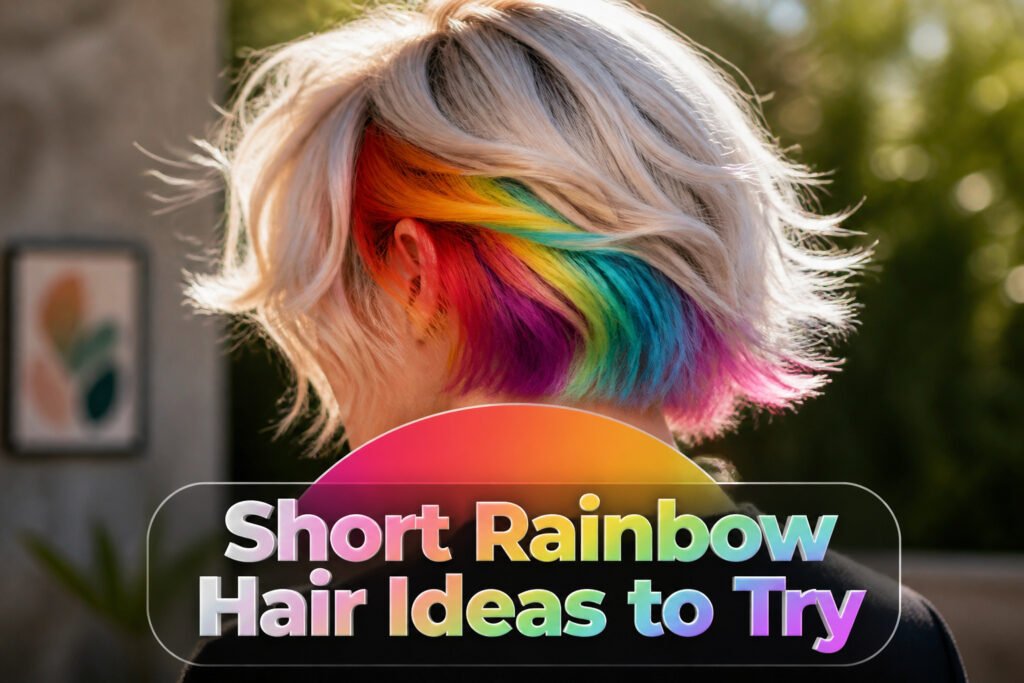
The peek-a-boo rainbow underlayer is the clear winner for anyone who needs their color to clock out when they do. Platinum blonde on top hides the panel completely during a blow-dry, and the rainbow only surfaces when you move or tuck hair behind an ear. Professionals get the full effect without the full risk, though the bleach touch-ups on that visible blonde layer still demand salon visits every four to six weeks to keep the contrast sharp. If you want rainbow hair that announces itself before you speak, skip straight to the saturated full rainbow, but plan on three-week root maintenance and a scalp that remembers every chemical pass.
1. Pastel Rainbow Waves
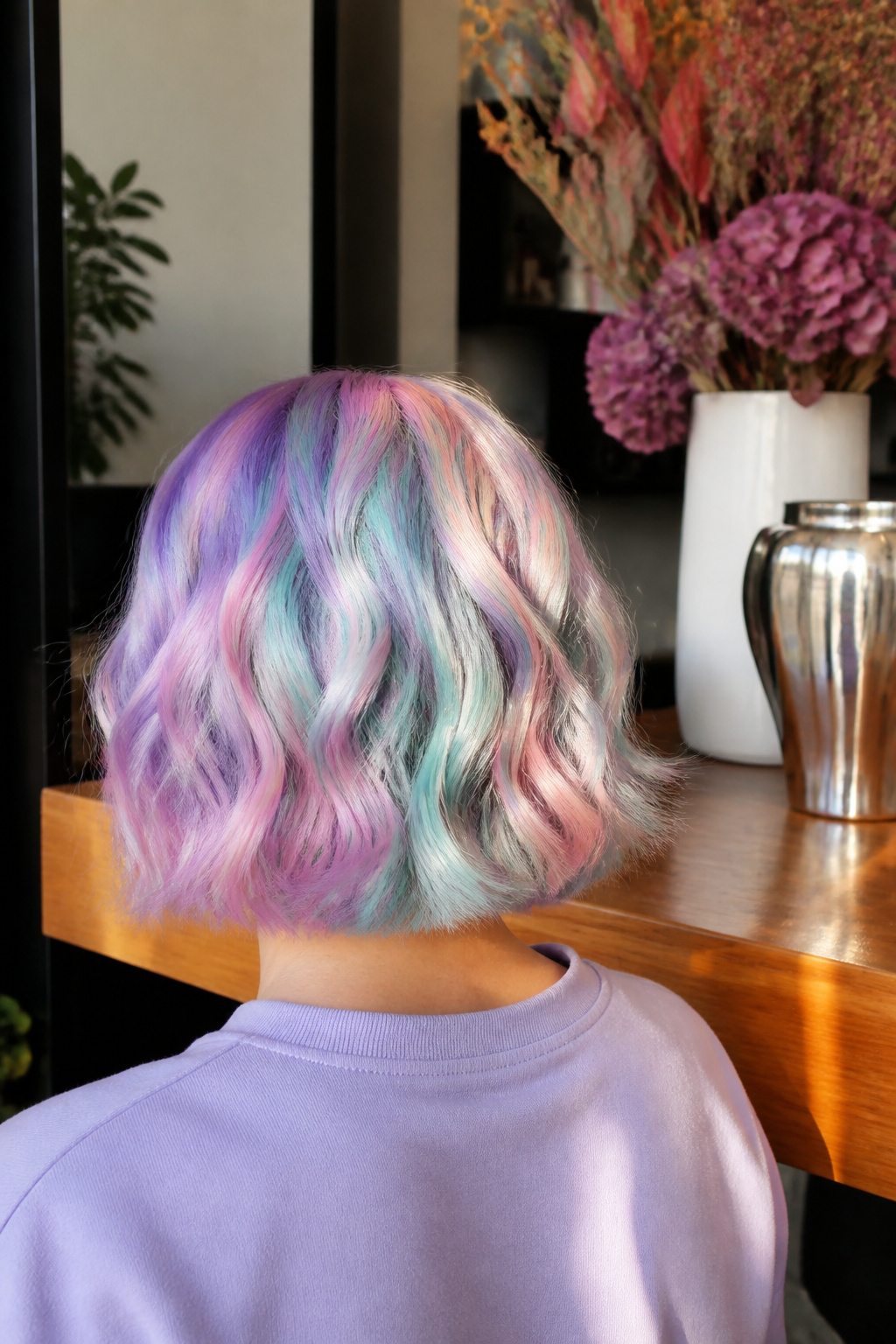
Pastel rainbow waves on short hair read softer than the same colors trailing down a back. The cropped length keeps every shade in view at once instead of letting them blur into one another, so placement matters more. I learned this watching how lavender and mint behaved differently after my own chop: the same tones that looked gentle in long layers turned almost neon when they sat right at the jawline with no dark length to anchor them.
The real cost of this style is the fade schedule. Pastels sit on the outer cuticle and wash out fastest exactly where light hits most, which on short hair means the crown and the ends framing your face. Those sections go first, and the contrast against whatever lingers underneath can look muddy rather than intentional. Plan on refreshing the top layers every two to three weeks if you want the gradient to stay deliberate rather than accidental. Cold water and sulfate-free shampoo buy a few extra days, but pastels on short hair are essentially a part-time commitment with a full-time appearance.
2. Ombré Sorbet Rainbow

Pink roots melting into a full rainbow gradient look almost edible on a chin-length cut, like someone turned a sorbet cup upside down on your head. The ombré technique on short hair means less real estate for the color to travel, so the transition from that hot pink base through orange, yellow, green, and blue has to happen fast. On a bob that barely brushes the collarbone, the whole rainbow sequence might only span three or four inches. That compression can look stunning in photos, but it also means the pink root line stays visible longer than you expect.
At the four-week mark, that pink band has usually faded to a softer rose or coral while the mid-length rainbow goes pastel or muddy. The contrast between the two zones gets muddy instead of crisp. A color-depositing conditioner in pink helps bridge the gap, though it will not restore the original saturation. The real maintenance call is whether to refresh the roots, shift the whole palette cooler, or let the fade become its own look. Most people I have seen try this either commit to root touch-ups every four weeks or lean into the washed-out version by month six.
3. Vivid Rainbow Underlight
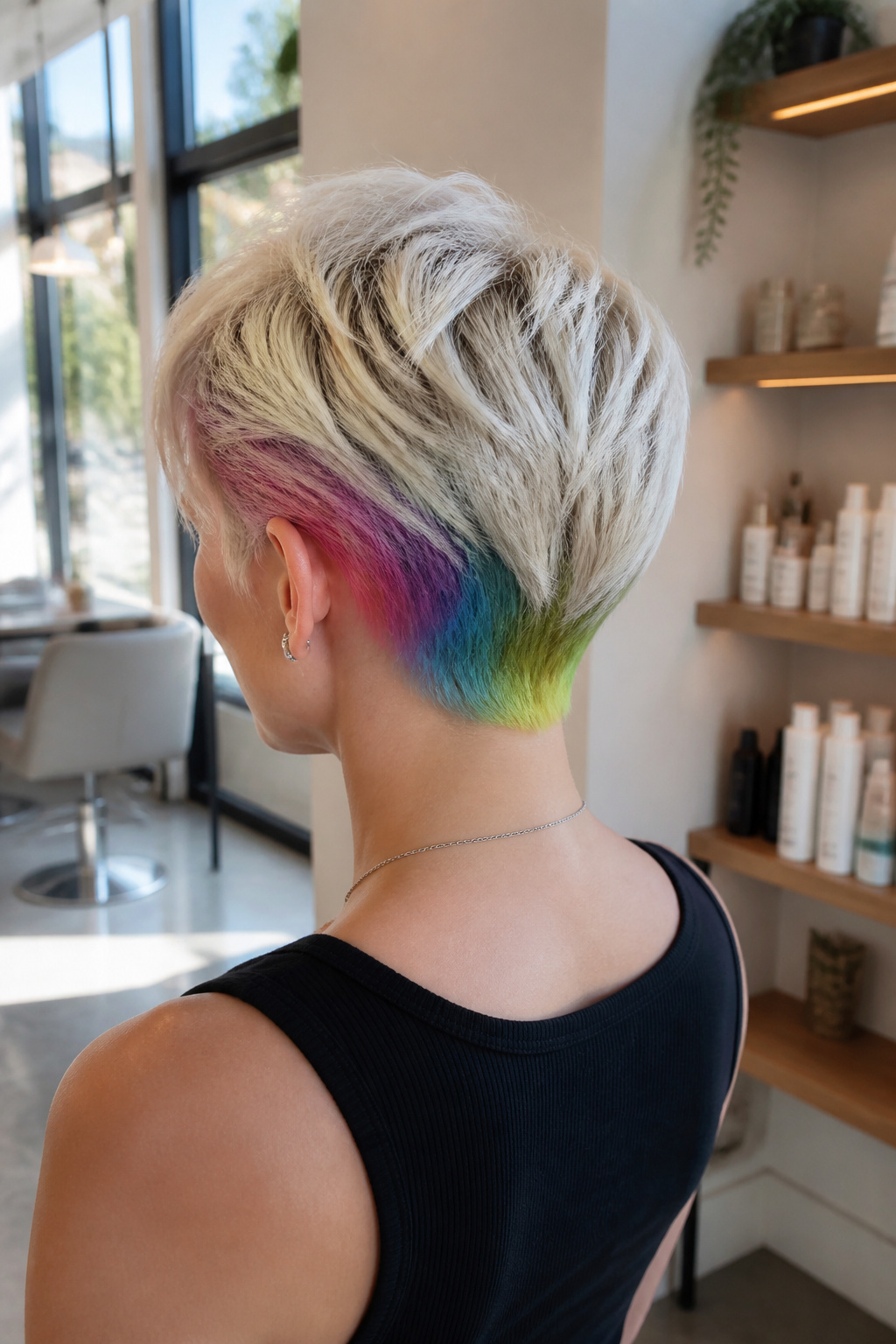
A peek-a-boo rainbow underlayer beneath platinum blonde gives short hair exactly the kind of secret the cut is built for. On a pixie or bob, the hidden panel only surfaces when you move, part your hair, or tuck it behind an ear. The rest of the time, the top layer reads as clean, bright blonde. That controlled reveal is harder to manage with longer hair, where length and weight tend to spill the color whether you want it shown or not.
The contrast against platinum matters. The lighter your surface color, the sharper the rainbow underneath reads when it does appear. Straight, curly, or wavy styling all work; the underlight shows through regardless of texture because the placement sits low enough to catch light and motion rather than relying on a specific shape.
For anyone keeping a professional appearance during the week, this is the most employable route to rainbow color. The top layer does the hiding for you. No root grow-out line announces itself at your part, and a quick blow-dry with the top section smoothed down returns you to neutral. The maintenance is in the bleach touch-ups on that visible blonde, not in managing multiple competing colors at the surface.
4. Dip-Dyed Rainbow Pixie
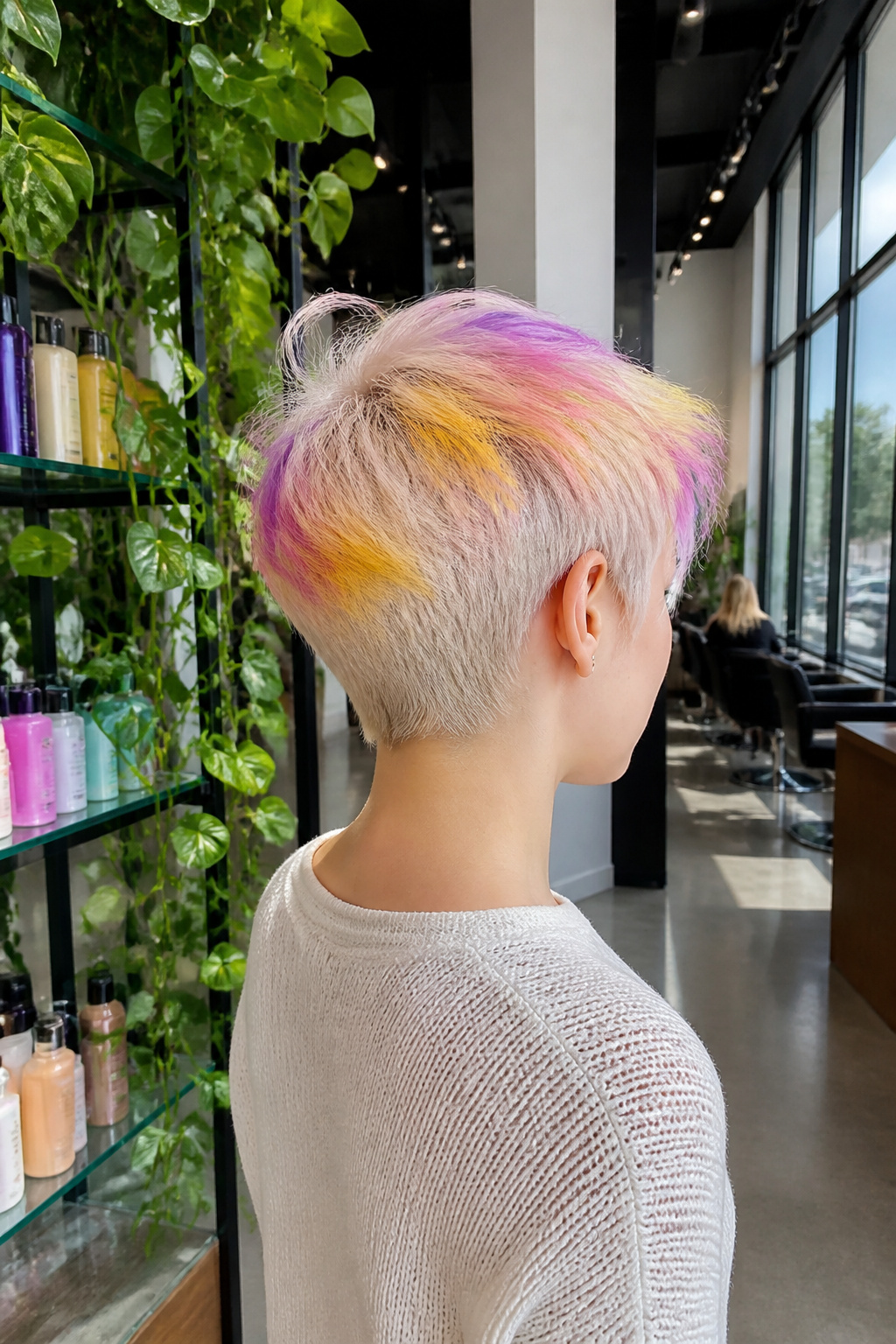
Platinum blonde gives a pixie cut a clean stage, and sprinkling the rainbow rather than flooding it keeps the look wearable instead of costume. The mistake I kept seeing, paging through salon portfolios, was loading four or five color zones onto hair that ends above the jaw. On short hair, each zone needs room to breathe, and a pixie simply does not have the real estate. Too many bands land like stacked stripes rather than flow.
This style keeps the color to a dip-dyed accent, usually at the ends or tucked along one side, so the platinum stays dominant and the rainbow reads as a controlled flash of dimension. One or two tones do the work that four would undo. The result still reads as short rainbow hair, but it moves with you instead of fighting the cut.
5. Crimped Rainbow Texture
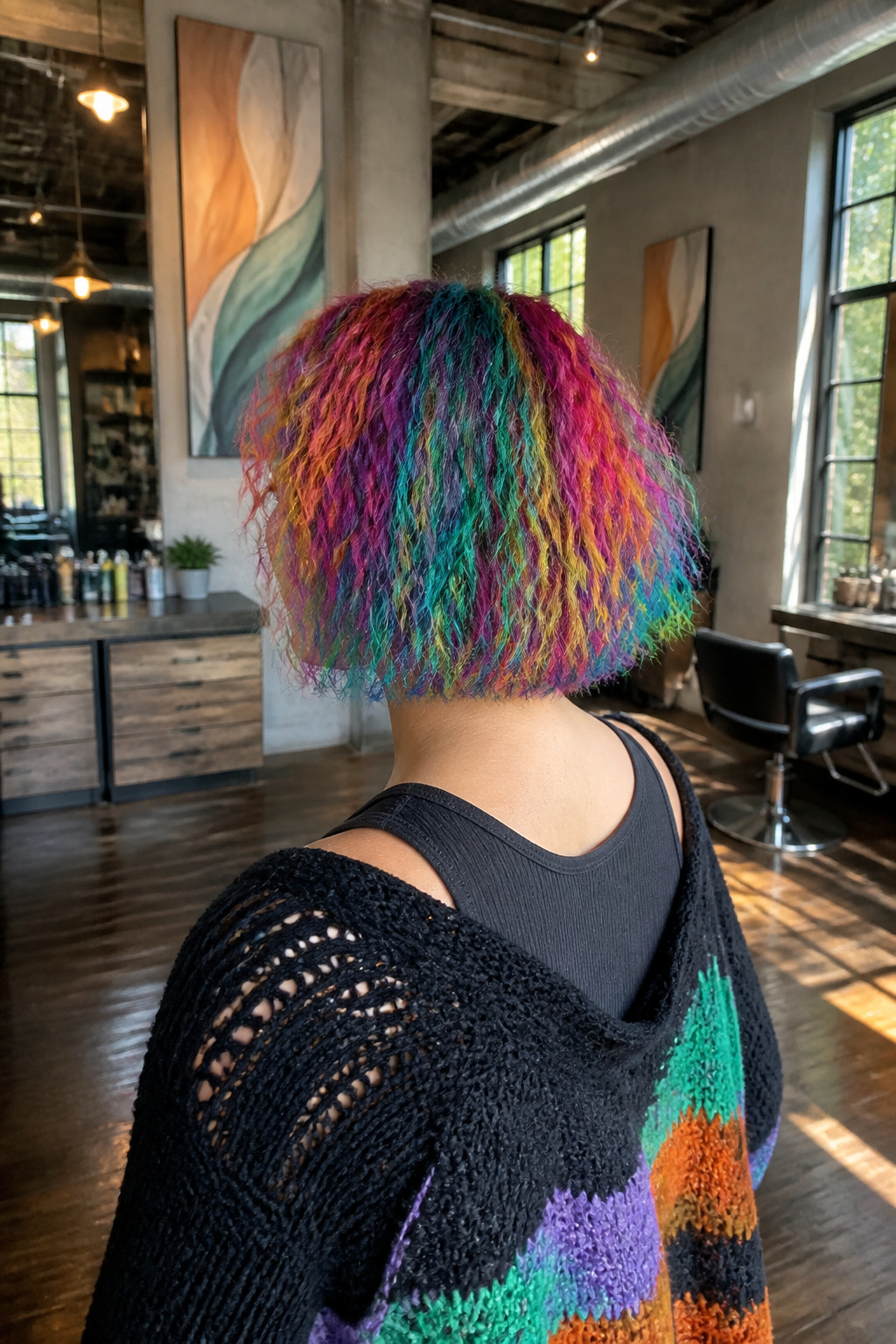
Crimping turns short rainbow hair into something closer to a holographic finish than any flat color could manage. The zig-zag surface catches light from multiple angles at once, so a three-color panel reads as six or seven depending on how you tilt your head. On a short cut, that multiplied reflection matters more because there simply isn’t much hair to work with; every millimeter of strand has to earn its place in the overall effect.
The tradeoff sits right in the tool. Crimping irons run hot, and rainbow hair has already been bleached, usually more than once to lift a dark base to the pale yellow that takes saturated pigment. Heat damage on already-stripped short strands shows up fast: snapping, a cotton-candy texture at the ends, color that washes out patchy because the cuticle won’t hold dye anymore. Your hair has less length to sacrifice before the damage becomes the style.
If the crimped look is non-negotiable, the protection step can’t be the afterthought it was for loose waves. Work in small sections, move the iron through quickly rather than clamping and holding, and accept that the definition will soften by day two. Some of the best crimped rainbow results I’ve seen in salon photos were actually day-old sets, the sharp edges relaxed into something that still caught light without the fried finish.
6. Swirly Rainbow Buzzcut
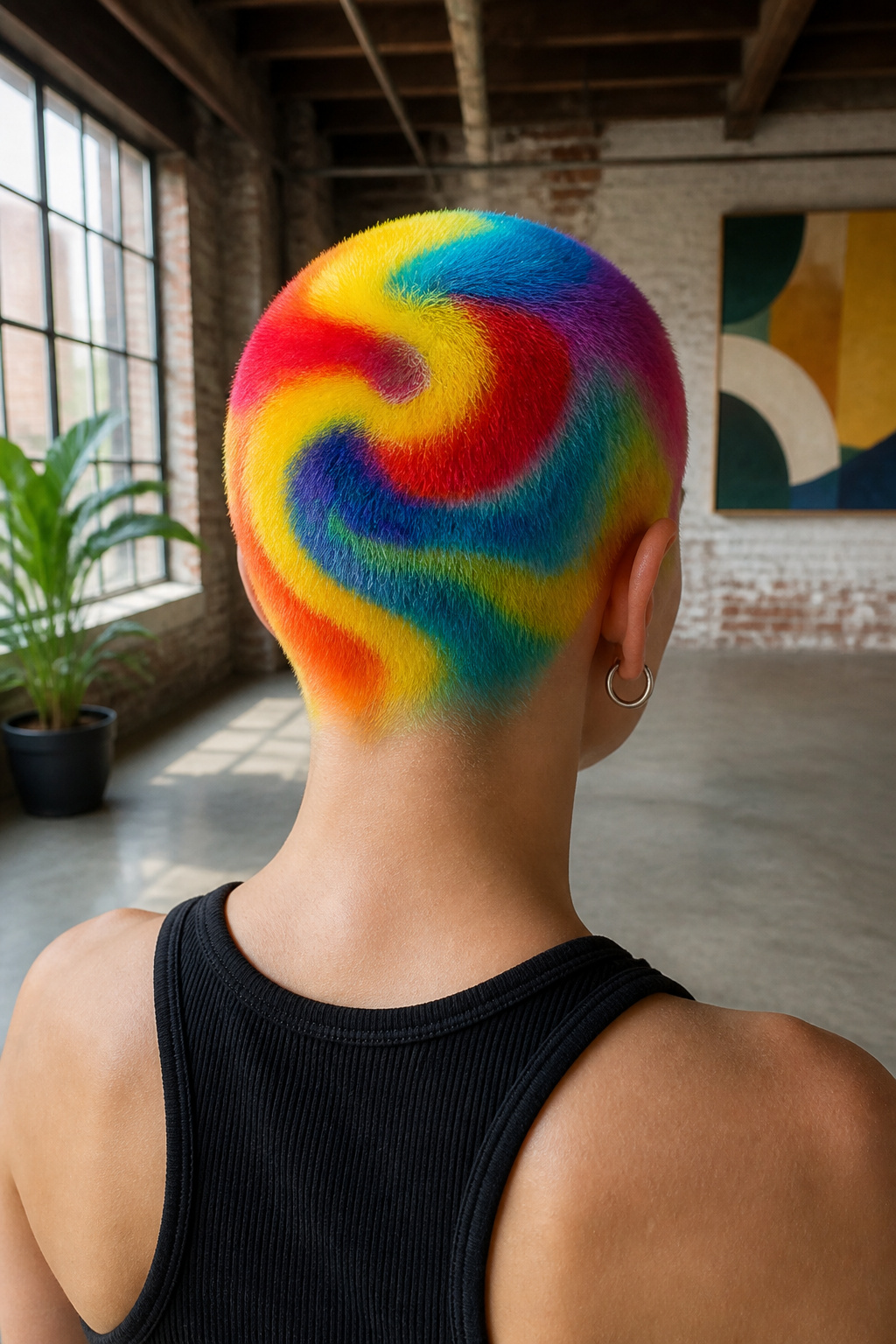
A bleached buzzcut is the closest thing to a blank canvas hair color gets, which is exactly why the swirly rainbow technique works here and almost nowhere else. The colorist soaks sponges in dye and stamps or paints freehand shapes directly onto the scalp, building curves and waves that follow the head’s contour rather than fighting it. Skin tone underneath changes everything about how those colors read. Pale scalp skin lifts yellow and orange into something electric; deeper skin tones push the same pigments toward a muted, almost neon-adjacent glow that photographs differently than it looks in person. Either way, the lifespan sits at roughly two to three weeks before regrowth builds enough stubble to break the clean edges and turn your swirling shapes into smudged watercolor. Shorter than almost any other rainbow option, but that is the trade for starting this close to the root.
"I can only dream of having rainbow hair this immaculate. To create this rainbow hair color trend, this colorist started with a bleached, shaved head, and then soaked sponges in the dye to create these rainbow shapes. I mean, talk about artistry."
The sponge method matters because brushes leave streaks on hair this short, and airbrushing demands equipment most colorists do not keep in salon. What the Cosmopolitan description leaves out is the maintenance math: plan on a full re-bleach of any regrowth if you want a second round, since new growth dark enough to need lifting will shift your color map entirely.
7. Rainbow Lob

A rainbow lob lands right at the collarbone, the longest cut that still counts as short hair. That extra length matters more than you’d think for color work. The deeper violet and midnight blue bases that anchor this style don’t need your hair lifted to pale blonde first. Less bleaching means less damage, and the darker pigments fade to something attractive rather than that washed-out yellow you get when neon green gives up.
Your natural brown or dark blonde can stay mostly intact underneath, which is why this became my recommendation for friends in their forties who asked about rainbow color but flinched at the maintenance stories. The jewel-tone ribbons, teal and garnet and indigo, sit on top of a base that doesn’t fight them. Touch-ups stretch to eight or ten weeks if you stick to richer shades rather than trying to force them pastel.
The grow-out line stays softer too. Where a platinum base would broadcast every quarter inch of root, a deep plum or navy transition lets you push the salon appointment without the stripe effect that makes most rainbow styles look tired fast.
8. Subtle Three-Color Rainbow
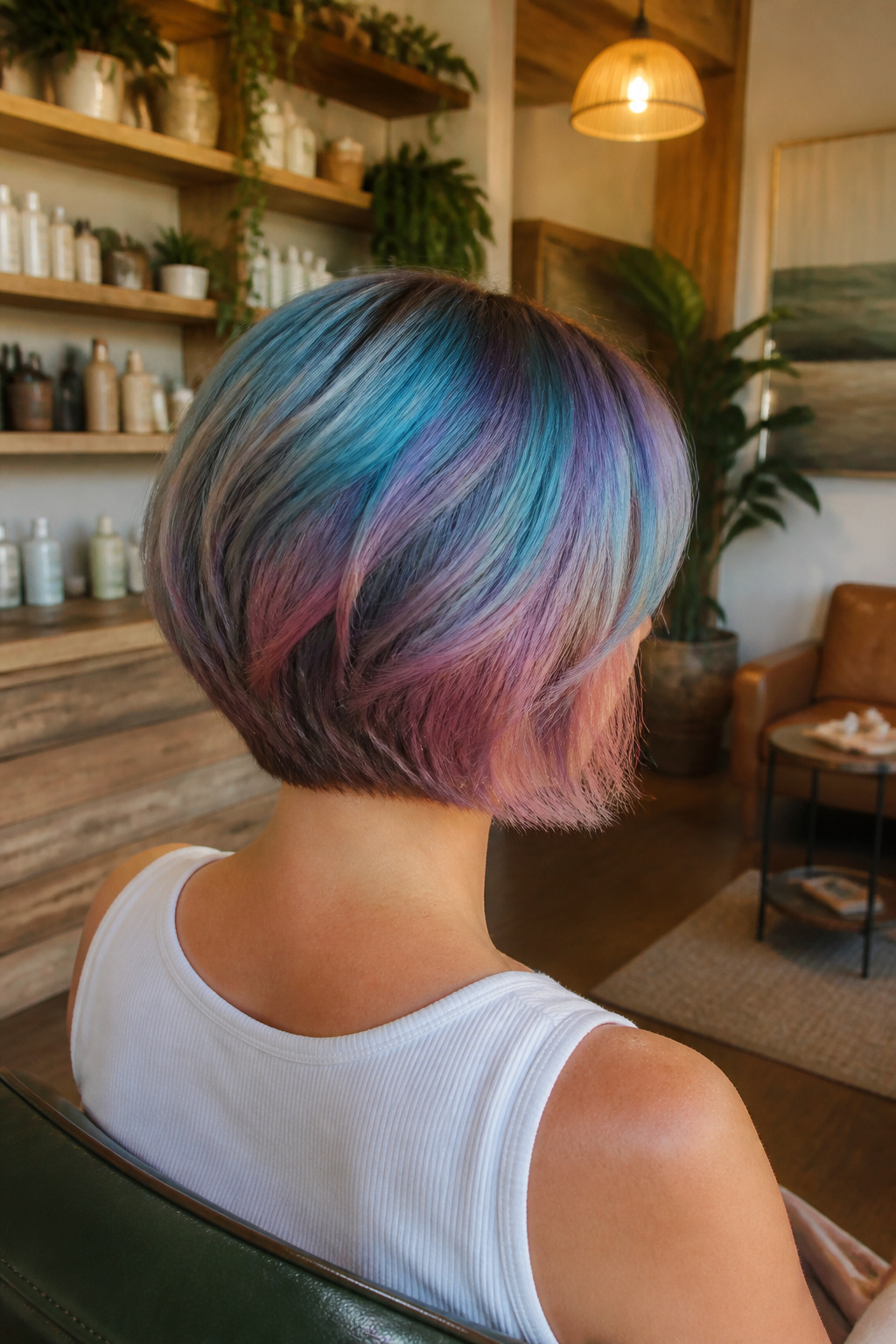
A three-color rainbow on short hair lives or dies by where you stop. The restraint reads as a choice, not a shortcut, because shorter lengths give you so little room to hide a scattered approach.
I learned this watching how stylists place color on a pixie: two tones live on the crown, the third anchors the nape or the fringe, and the negative space between them does the work of making each hue feel considered. Platinum blonde acts as the quiet frame in the best versions, letting the rainbow read as dimension rather than costume. The palette itself needs discipline too. Teal, violet, and a single warm tone (coral or soft gold) carry enough contrast to register as rainbow without demanding the full spectrum. More than three and the eye starts hunting for a pattern that short hair cannot complete.
Placement follows the same rule. Keep every color within two inches of its neighbor so the transition looks deliberate, not like grow-out you have not fixed. On a chin-length cut, that usually means color starting at the parietal ridge and moving down, never floating alone on the ends where short pieces cannot support the weight of saturated pigment.
The finished effect registers as "rainbow" because the colors sit in the right relationship, not because they cover enough ground to prove it.
9. Peekaboo Purple Rainbow
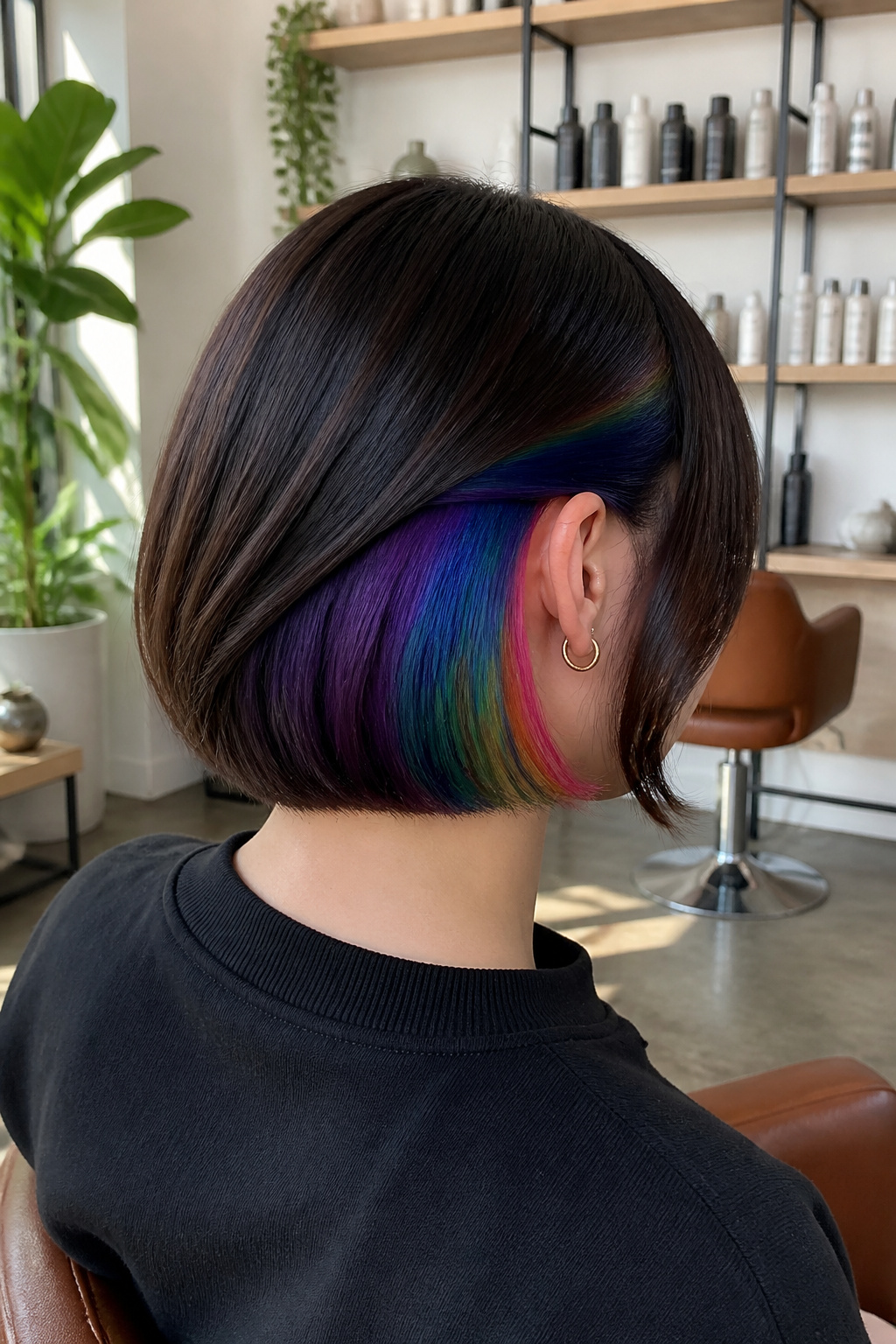
A mostly purple base with a thin ribbon of rainbow tucked underneath or behind the ear reads as professional in most offices while still carrying a secret. The color sits where a ponytail or tuck reveals it and a standard part hides it completely. For short hair, that slice lands best at the nape or along one temple, narrow enough that a quick blow-dry blends it away.
What sold me on this approach, reading through dozens of client photos, is how it ages across appointments. A full rainbow demands every tone be refreshed at once; the purple-to-rainbow ratio here means root touch-ups on the dominant color can stretch to eight or ten weeks while the hidden accent fades invisibly. The visible result stays clean even as the hidden band softens.
Placement matters more than shade choice. A money-piece highlight framing the face is the alternate read on this same idea if the underlayer feels too concealed. Either way, one dominant color with a hidden accent carries far less risk for working professionals than full commitment, and short hair keeps the maintenance compact enough to manage at home between salon visits.
10. Neon Rainbow Top Half

On short hair, the top half is a much smaller canvas than it would be on longer lengths, maybe thirty to forty percent of your total hair rather than half. That compact area means the neon rainbow reads as a bright cap rather than a heavy veil, and the natural color underneath does the work of adding depth so the colors don’t flatten out.
The geometry matters more than you’d think. With a pixie or a bob, the top section sits right where light hits first, so the neon gets full exposure without your whole head committing to the maintenance cycle. The underneath stays whatever you woke up with, which means no bleach damage on the lower strands and no visible roots marching down your neck when the color starts to shift.
A ponytail or half-up style shows the split cleanly, and on short hair that contrast is the whole point. You’re not hiding the natural tone; you’re using it as the anchor. The grow-out line also stays kinder. When the top color fades or your roots come in, the boundary blends into the darker lower layer instead of sitting exposed against a full bleach job.
11. Saturated Full Rainbow
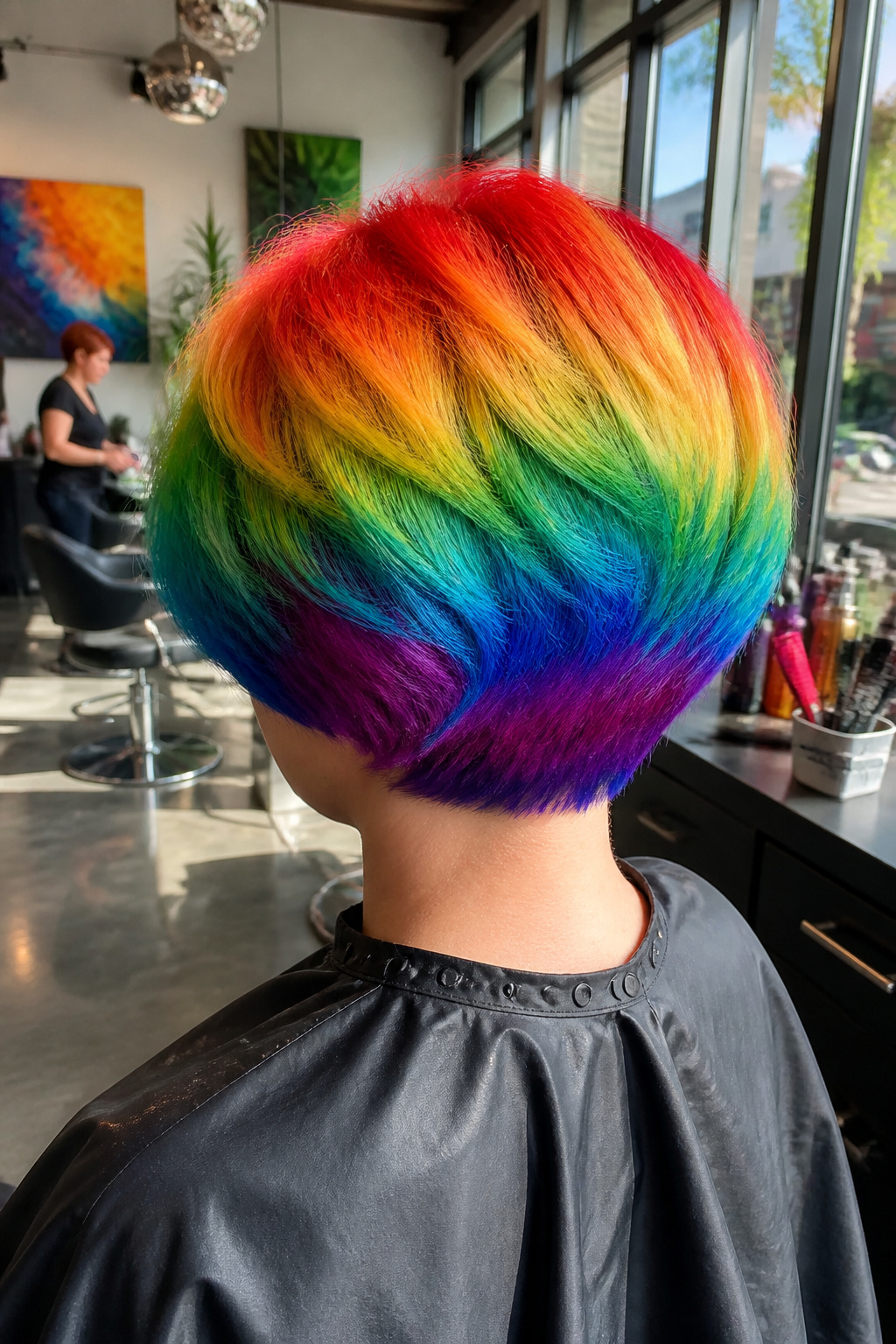
A saturated full rainbow on short hair means bleaching every visible strand to pale yellow first, then laying down red, orange, yellow, green, blue, and violet in distinct bands. The result is loud, immediate, and impossible to miss. What convinced me, reading through a dozen accounts of this, is that the scalp burn during bleaching is real and cumulative; short hair leaves no buffer between chemical and skin, and the second or third touch-up hurts worse than the first.
Three-week root maintenance is non-negotiable. Natural growth against rainbow bands looks like a hard line, not a soft grow-out, and the contrast is harsher on short cuts where there is no length to distract. Someone with sensitive skin, a tight schedule, or a preference for low-effort mornings should skip this entirely. The payoff is maximum impact, but the cost is a standing salon appointment or a careful, lengthy home session every month.
12. Holographic Waves

A true holographic finish on short hair is not the same thing as a standard rainbow dye job. Standard rainbow lays down distinct bands of color next to each other, but holographic color shifts based on how the light hits it, using softer, iridescent tones that seem to float over a pale base rather than sit inside it. The Suicide Squad look that made this trend visible paired those shifting tones with a platinum blonde foundation, which is what lets the dimension read as metallic rather than striped.
Short hair shows the effect better because there is less length for the colors to compete. On long hair, holographic sections tend to blur into a single muddy cast by the time the eye travels down the strand. A pixie or cropped cut keeps each panel of color in its own zone, so the shift from silver to lavender to pale mint actually registers as separate moments. The technique also differs: instead of applying color in horizontal blocks, stylists work in fine vertical panels, sometimes using a comb to drag and feather the edges so no hard line breaks the illusion.
The product side matters too. Holographic color relies on conditioners and glosses with translucent pigment rather than the opaque dyes used for vivid rainbow work. Those sheer layers build the prismatic effect; opaque color would kill it. If your base is not lifted to a clean pale blonde first, the result reads as dull pastel, not holographic. The platinum foundation is non-negotiable.
13. Prismatic Curls

Curls do something to rainbow dye that straight hair never will. Each coil catches light on its outer curve and hides it in the shadow beneath, so a single streak of cobalt reads as three or four distinct blues depending on where your head tilts. The pattern breaks deliberate color placement into unpredictable patches that shift with every bounce, which is the whole point of choosing curls for this look.
Placement has to follow the coil rather than fight it. A colorist working on straight hair can draw clean horizontal bands that stay where they land. On short curly hair, those same bands compress at the root and stretch at the ends as the curl forms, so the rainbow reads as muddy stripes instead of scattered light. What works better is painting color in vertical slices that travel the length of individual curl clumps, letting the natural spiral do the fragmenting. The result is prismatic in the literal sense: light scattered by geometry, not by careful design.
Your curl pattern also determines how much of any single color shows at once. Tighter coils hide more pigment inside the spiral; looser waves let larger panels catch the light. That density difference means the same dye formula reads more saturated on a 3A wave than on a 4B coil, something to account for when you are mixing your tones or describing the finish you want. Straight hair gives you control. Curls hand that control to physics, and the trade is exactly what makes this version worth trying.
14. Bright Pink Rainbow Focus

Hot pink on short hair lands harder than the same shade on a cascade of length, because there is simply less surface to compete for attention. The eye goes straight to the color instead of wandering through it. A limited palette, one or two colors like hot pink, also means touch-ups match without a chemistry project in your bathroom; leftover dye from the original mix keeps better when you are not juggling six formulas. Less waste, less fading mismatch between roots and ends. Curly textures especially carry the punch well, though the upkeep demands real moisture: deep conditioners, hair masks, and leave-in conditioners belong in the rotation from day one. Volume helps the color read as shape rather than flat paint, so a thickener or texture spray at the roots keeps the cut from looking like a helmet. The trade is commitment without chaos: bold, but bounded enough to live with.
15. Pastel Peekaboo Spring Highlight

Pastel under-lights read as spring because the colors themselves arrive with the season. Lilac, mint, butter yellow, and pale coral show up in the first tulip beds and in the lighter wardrobe people pull out when the heavy coats go to storage. On short hair, these shades behave differently than they do on long. A longer cut lets under-lights disappear entirely between salon visits; the top layer falls straight down and the color only surfaces when you move. Short cuts refuse that full concealment. The weight line sits higher, so the pastels peek at the jaw or the cheekbone even when your hair falls still. The effect is less hidden gem and more intentional accent, like a lining sewn into a cropped jacket that flashes at the cuff. For spring specifically, that partial visibility works in your favor. The colors feel tentative in a way that matches the season, not the full commitment of a saturated rainbow but something that looks like it could fade with the cherry blossoms. Placement matters most on a pixie or a bob: ask for the lightest pieces at the nape and heavier saturation toward the occipital bone, so the color frames your face when you tuck one side behind your ear. The grow-out on short hair also moves faster into view, which means the pastel either needs refreshing every four to six weeks or you lean into the roots as part of the look.
16. Deep Purple Rainbow Base

A deep purple base lets you carry real rainbow saturation without lifting your hair past the point of no return. The darkness underneath does the heavy lifting, so a vivid teal stripe or an orange panel reads as intentional contrast rather than a mistake left in too long.
My own hair was already on borrowed time after a round of highlights that pulled too warm, so the idea of bleaching everything light enough for a true prism effect made me wince. Purple solves that. You keep the shadow at the root and through the back, painting the rainbow only where the cut exposes it, along the crown or through the fringe on a pixie. The maintenance shifts too. Purple fades in a direction that still looks deliberate, whereas a botched yellow or patchy pink on porous ends announces itself immediately. For short cuts especially, where there is no length to hide uneven processing, that margin matters more than the color itself.
17. Sorbet Curls Without Full Rainbow

Bright orange and pink together read as rainbow energy without the full commitment, and that distinction matters more than it sounds. Seven colors fade at seven different rates; chasing each band through its own awkward phase turns upkeep into a second job. Two colors, especially warm neighbors like these, shift in the same direction and give you longer stretches where the whole head still makes sense.
The sorbet pairing works on curls because the natural shadow between ringlets breaks the color into smaller pieces, so the eye fills in variety that isn’t actually there. Your colorist can lay the orange closer to the roots and let the pink take the ends, or reverse it; either way, the grow-out line stays softer than a hard rainbow block. Stock deep conditioners, hair masks, and moisturizing leave-in conditioners before you sit in the chair, not after the first wash when the dryness shows. For volume at this length, hair thickener and texture spray do more than the color itself to sell the look.
18. Lisa Frank Shoulder Length

Lisa Frank folders and stickers saturated the 90s with hot pink, electric purple, and acid green, and those same saturated hues land differently on a shoulder-length cut than they do on waist-length mermaid waves. The shorter canvas keeps the look from reading like a costume because the color stops before it becomes a full narrative; there is simply less hair performing the reference, which lets the wearer control the volume.
The risk of looking like you are headed to a themed party sits right at the saturation dial. On a professional woman, keeping the roots natural or very dark grounds the neon enough that the colors read as deliberate rather than impulsive. A colleague who pulled this off kept the top two inches near-black and let the Lisa Frank palette start at ear level, so the effect emerged only when she moved.
Placement matters more than hue choice here. Concentrating the rainbow on the ends, or framing just the face with alternating streaks, preserves the nostalgia without demanding that anyone take it in all at once. The shoulder length gives you that option; any shorter and the colors fight each other for space, any longer and the reference becomes too literal to escape.
Color Application Reality

Short rainbow hair demands more bleach than most people expect, especially at the back and sides where the hair is densest. The colorist has to lift your natural pigment to a pale, even blonde before any rainbow tone will read true, and on a pixie or bob there is nowhere to hide a patchy lift. That is why a professional who works with vivids regularly matters more for short cuts than for long; the margin for error is a quarter inch, not four inches of extra length to blend away a mistake.
In the consultation, ask specifically how the colorist plans to section a short cut for multiple hues. Long hair can be balayaged or foiled in panels, but short layers need a different mapping so the colors do not muddy where they overlap at the crown. Ask, too, whether they intend to pre-lighten the whole head or isolate zones, because the growout pattern on short hair means you will see roots faster and the touchup strategy changes accordingly. I would also want to know if they formulate the rainbow shades themselves or use a direct dye line out of the tube; custom mixing tends to fade more gracefully on short hair that gets washed and restyled daily.
Maintenance for Fading Color

Short rainbow hair lives or dies by how you treat it after the salon, and the damage from lifting dark pigment to hold those bright dyes leaves the cuticle about as porous as a sponge. What convinced me, reading through a dozen maintenance guides, is that oil applied to damp, not dry, strands locks in moisture without sitting on top like a greasy film. Argan or jojoba, both plant-derived and familiar to anyone already checking labels, sink in fast on a pixie cut where you have less length to distribute product through.
Leave-in conditioner matters more here than on longer styles because short hair has fewer old growth inches to buffer the bleach damage. The 35-54 readers I see in product reviews consistently favor formulas where coconut oil or shea butter appears early in the ingredient list, not buried under silicones they cannot pronounce. Skip the standard supermarket shampoo unless you want that teal fading to dishwater in under three weeks. A sulfate-free, color-safe wash with a pH closer to 4.5–5.5 keeps the cuticle closed and the pigment trapped inside where it belongs.
Spring Timing and Seasonal Fade
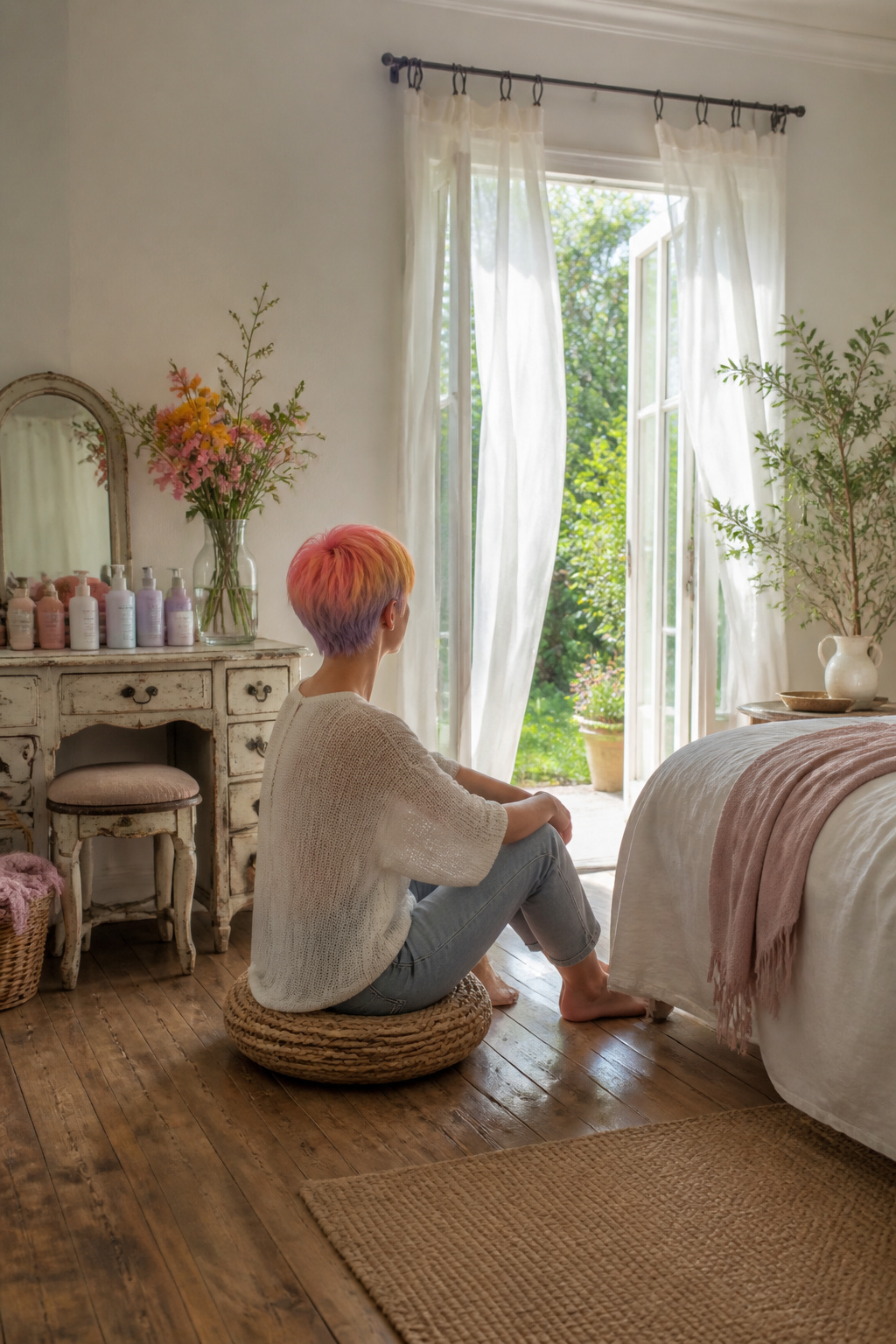
Spring arrives with the same brief window of permission that makes short rainbow hair feel right instead of reckless. March is when salons start booking these appointments in earnest; the color reads as renewal, not costume, and the first warm days give you enough light to actually see the shift between tones. That timing matters because the fade is part of the design, not a failure. Pastel rainbows wash out toward blonde by June, vivid ones settle into a softer version of themselves, and either path looks intentional against a tan. By August you’re choosing: refresh the full spectrum, let it fade to a single residual tone, or cut the grown-out inches and start clean. I lean toward planning the fade as carefully as the initial dye, since a washed-out rainbow on damaged ends is the only version of this look that truly ages badly.
Frequently Asked Questions
What are the best rainbow hair ideas for short hair?
Pastel waves, ombré sorbet, vivid underlights, and dip-dyed pixie cuts all work well on short hair because the cropped length keeps every shade visible at once rather than letting them blur together. The best choice depends on how much maintenance you want: pastels need refreshing every two to three weeks, while hidden underlights or a deep purple base with rainbow accents can stretch to eight or ten weeks between touch-ups.
How do I maintain rainbow hair?
Cold water and sulfate-free shampoo buy a few extra days of vibrancy, but the real maintenance depends on your style. Pastels on short hair are essentially a part-time commitment with a full-time appearance, requiring top-layer refreshes every two to three weeks. For longer stretches between salon visits, choose deeper jewel tones on a darker base, use color-depositing conditioners to bridge fading gaps, and protect already-bleached strands from heat damage by working quickly with tools rather than clamping and holding.