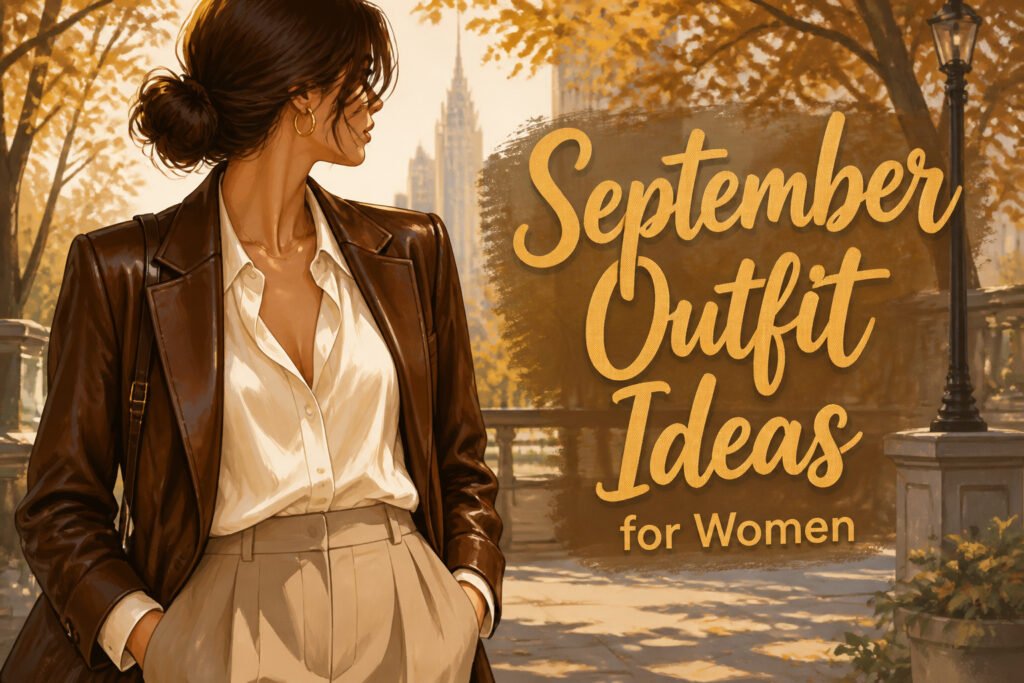
September outfit ideas sit somewhere between resisting the heat and admitting the season has turned. The ones that work share a single rule: one piece carries summer weight while another does fall’s structural job. A leather blazer over tailored trousers, for instance, uses monochrome accessories to keep the line intentional rather than costumed.
1. Leather Blazer With Tailored Trousers
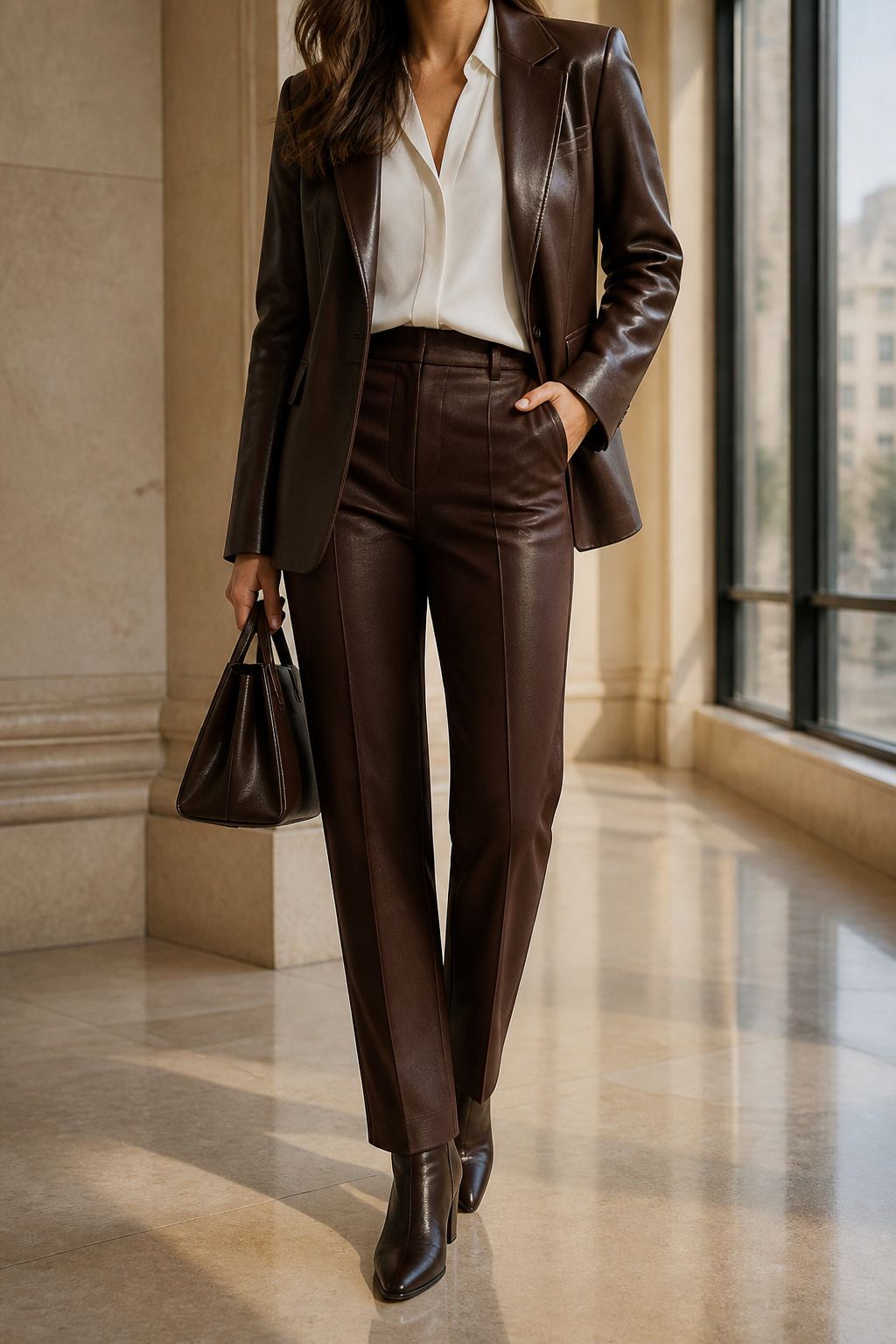
A leather blazer over tailored trousers solves the September problem of looking dressed without sweating through a wool coat. The jacket carries just enough weight for evening chill, and creased trousers in the same tone keep the line long and intentional. What makes this pairing work now, rather than later in fall, is the monochrome accessories that finish it: one color head to toe, no competing hardware or prints to break the silhouette.
I saw this formula labeled as one distinct look in the seasonal roundups, and the logic holds. A leather blazer bridges the gap between summer evening weight and the structure you actually want once Labor Day passes. Wide-leg trousers with a pressed crease give it office credibility; tonal shoes and bag keep it from reading like costume. The sources noted this as an age-old combination, which usually means it resists trend dating. For anyone already checking ingredient lists on skincare, the equivalent here is fabric content: real leather breathes differently than bonded, and trousers with enough wool to hold a crease will outlast September into October.
2. Bomber Jacket Over Polo Sweatshirt and White Skirt
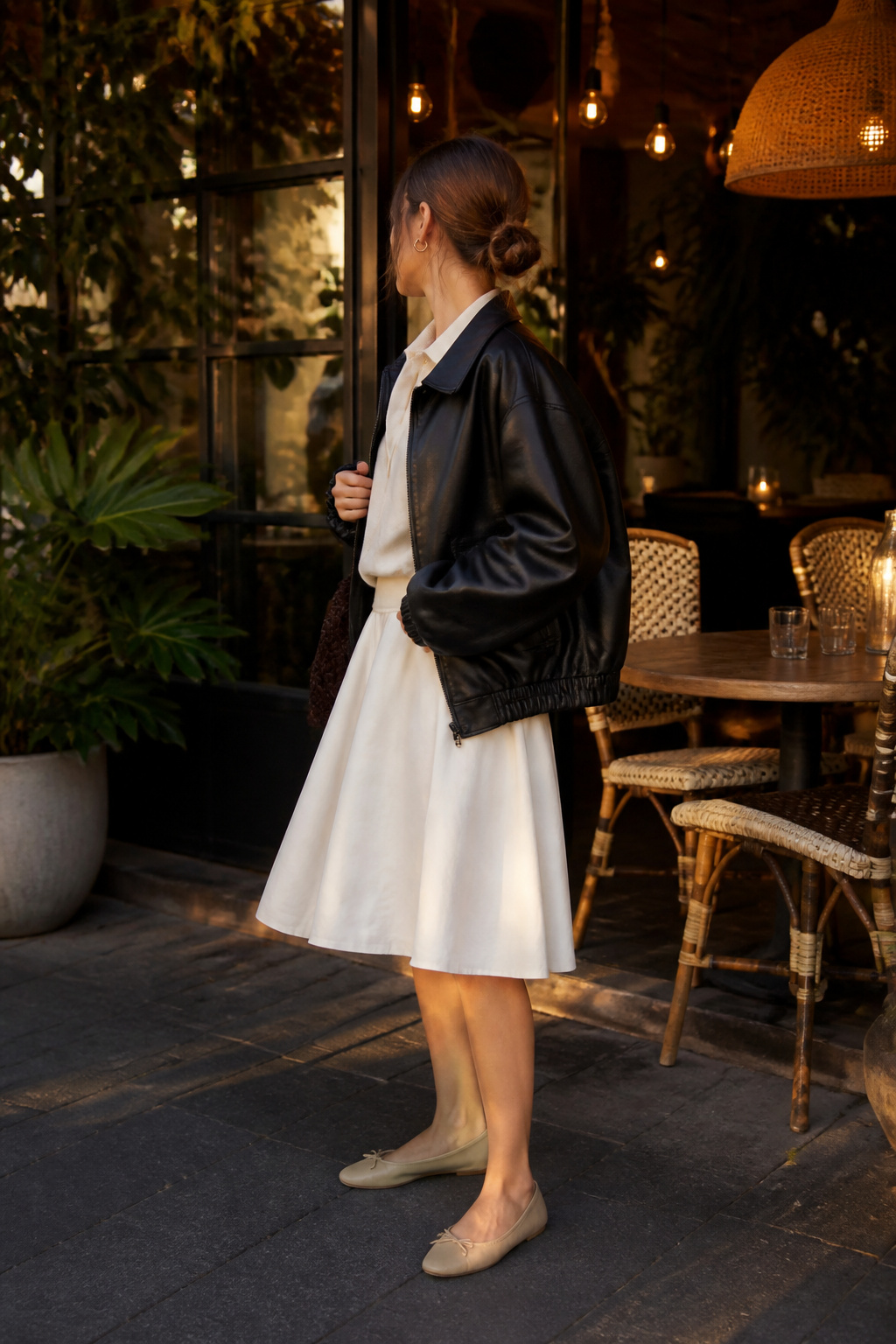
A polo sweatshirt under a leather bomber bridges the gap between summer’s last white skirts and the first real chill of September. The collar gives you structure without the stiffness of a full button-down, and the sweatshirt body keeps the look relaxed enough for a Saturday of errands.
I wore this combination on a day that started at 75°F and dropped to 60°F by four o’clock. The bomber came off by noon, went back on at three, and the outfit never felt wrong at either temperature. The white skirt does the heavy lifting of keeping one foot in summer dressing; the leather and wool-cashmere knit do the work of pushing it forward.
Two ways to ground it. Suede heeled ballerinas keep the line elegant and work for offices that still allow open footwear. If your September looks more like walking than sitting, swap in whatever flat you already trust for distance. The Frankie Shop’s Viper jacket and Róhe’s wool-cashmere polo are the versions that carry straight through winter, but the shape is what matters: cropped jacket, collared knit, crisp bottom.
3. Button-Down Shirt With Jeans and Mules
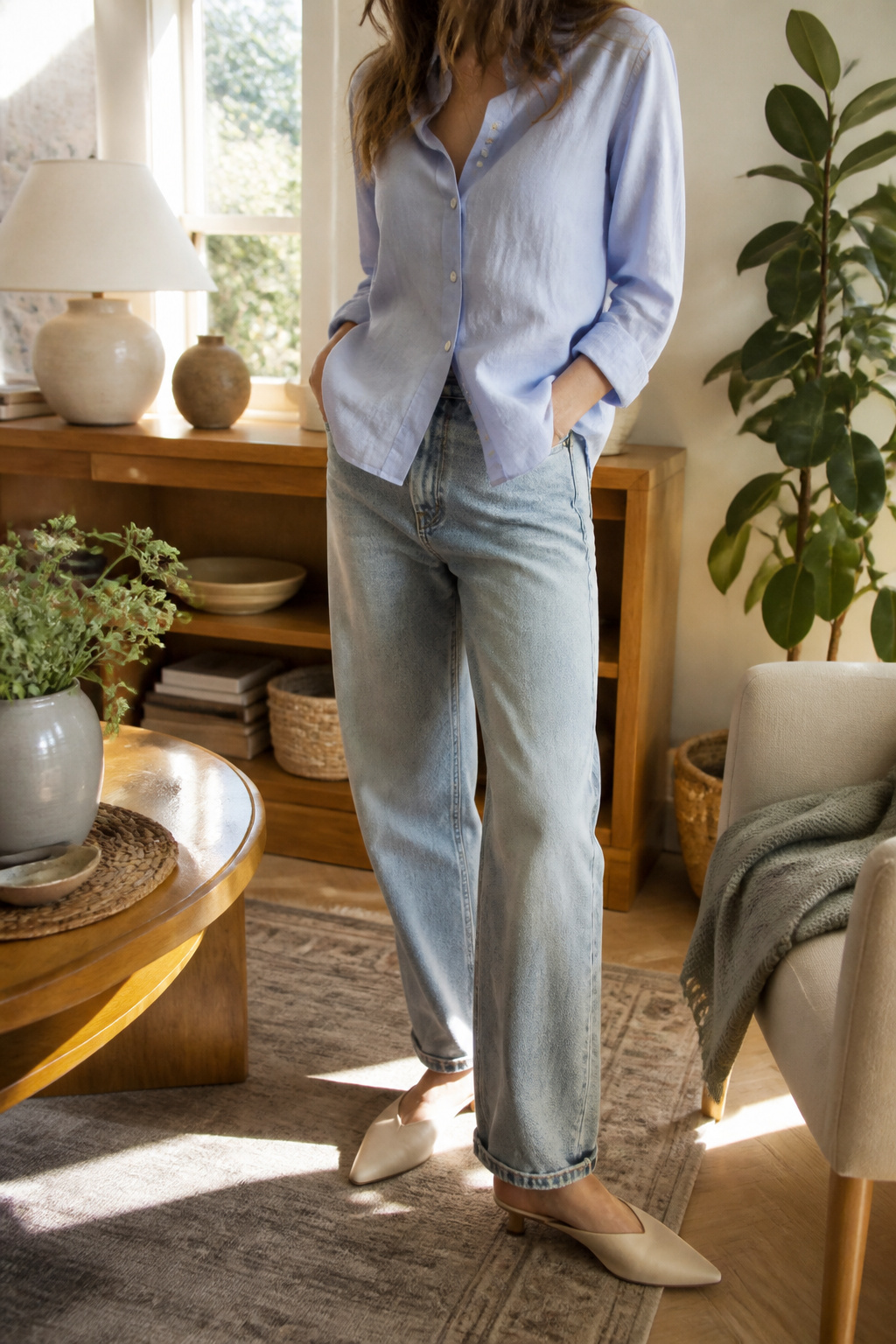
A crisp cotton or linen button-down with straight or slightly baggy jeans and a mule that slides on without socks is the silhouette that keeps showing up in every September roundup I looked at. The combination works because it lands right in the mid-70s to low 80s°F range that early September still delivers, before the evening drop forces you into layers.
The shirt material matters more than the cut. Cotton holds structure through humidity; linen breathes better but wrinkles into a rumpled look by lunch, which some people want and others don’t. I lean toward cotton for days with meetings, linen for Saturdays.
Jeans should sit at straight or slightly baggy, nothing cropped or tight. The mule does the seasonal translation here: a closed-toe shoe reads fall, but the open back keeps you from overheating when the afternoon still feels like August. No socks, ever. The whole point of the mule is that it slips on and off, and socks turn it into a different shoe entirely.
One styling move that keeps this from looking like you grabbed whatever was clean: half-tuck the shirt, leave the bottom two buttons undone, and roll the sleeves to just below the elbow. It takes fifteen seconds and changes the proportion from boxy to intentional.
4. Wool Blazer Over Midi Dress

The wool blazer is the first true fall-weight piece that earns its keep in my September rotation. Upper 60s°F highs in late September mean a sleeveless or short-sleeve midi dress from August still works, but only with something substantial on top. A mid-calf dress length gives enough leg coverage that tights stay in the drawer for now; the blazer handles the rest. Boxy cuts read sharper than fitted ones here, and the weight matters: summer’s linen blazer won’t cut it once the afternoon high barely grazes 70°F. What convinced me, reading through enough of these transitional formulas, is how the midi length does the practical work while the wool does the thermal work. No single piece has to overcompensate. Keep the dress light, make the blazer heavy, and you get two more weeks out of a summer favorite before October demands the full switch.
5. Long-Sleeve Top With Track Pants and Slingbacks
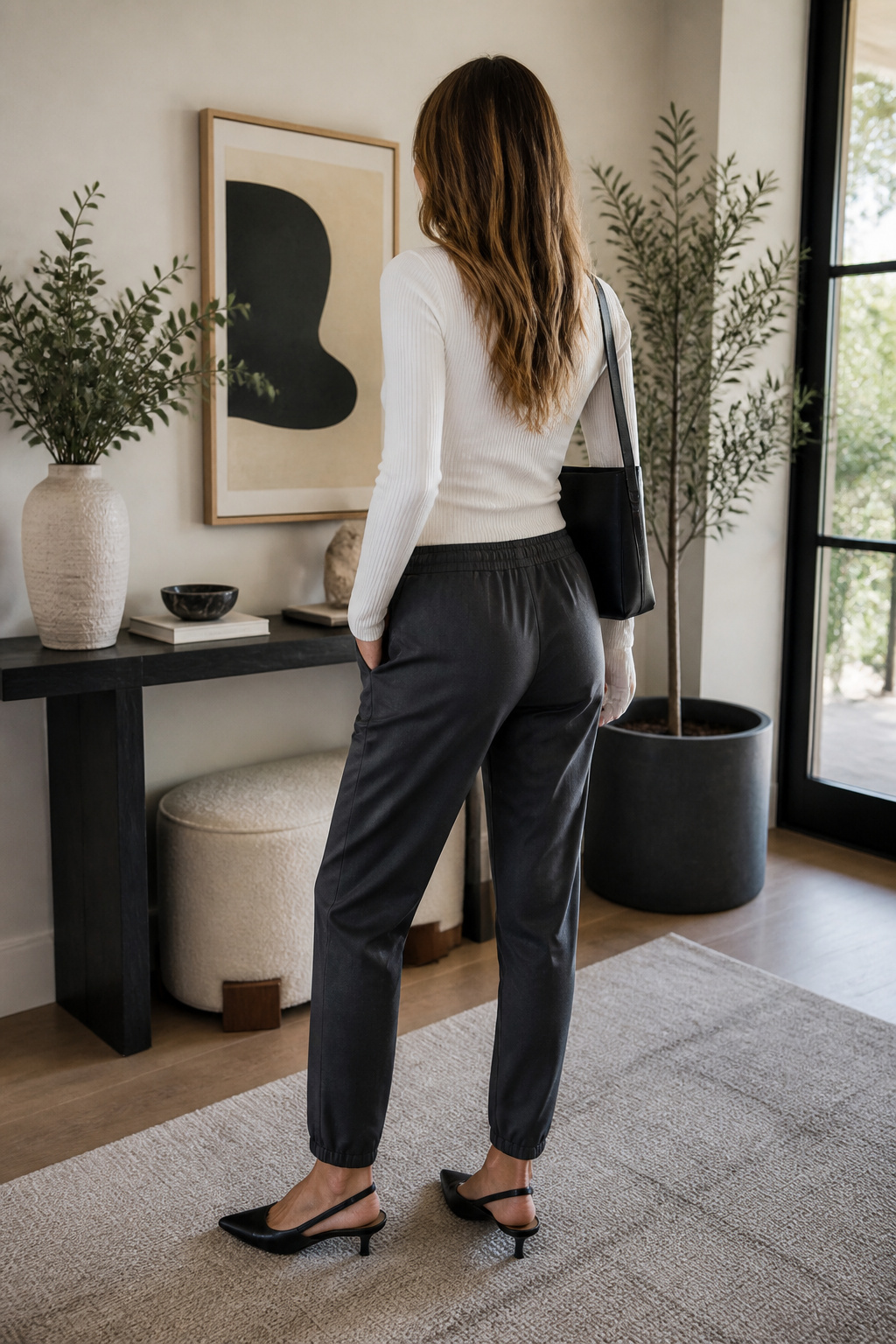
Track pants in September need a shoe that says you left the house on purpose. A slingback heel does exactly that, taking the look far enough from gym territory that nobody asks if you’re coming from a workout. The long-sleeve top adds the coverage those cooler morning commutes actually need, and the fitted shape keeps the silhouette from drowning in fabric.
The pants themselves matter more than the pairing. A substantial cotton or a proper tech fabric holds its structure; thin jersey sags and reads like you grabbed what was on the chair. The baggier the cut, the more deliberate the shoe needs to be. Kitten height works for office days, something sharper for evening. What convinced me, reading through enough of these combinations, is that the contrast is the whole point: soft against structured, casual against polished. Get one element wrong and you’re either underdressed or trying too hard.
6. Shorts Under a Blazer
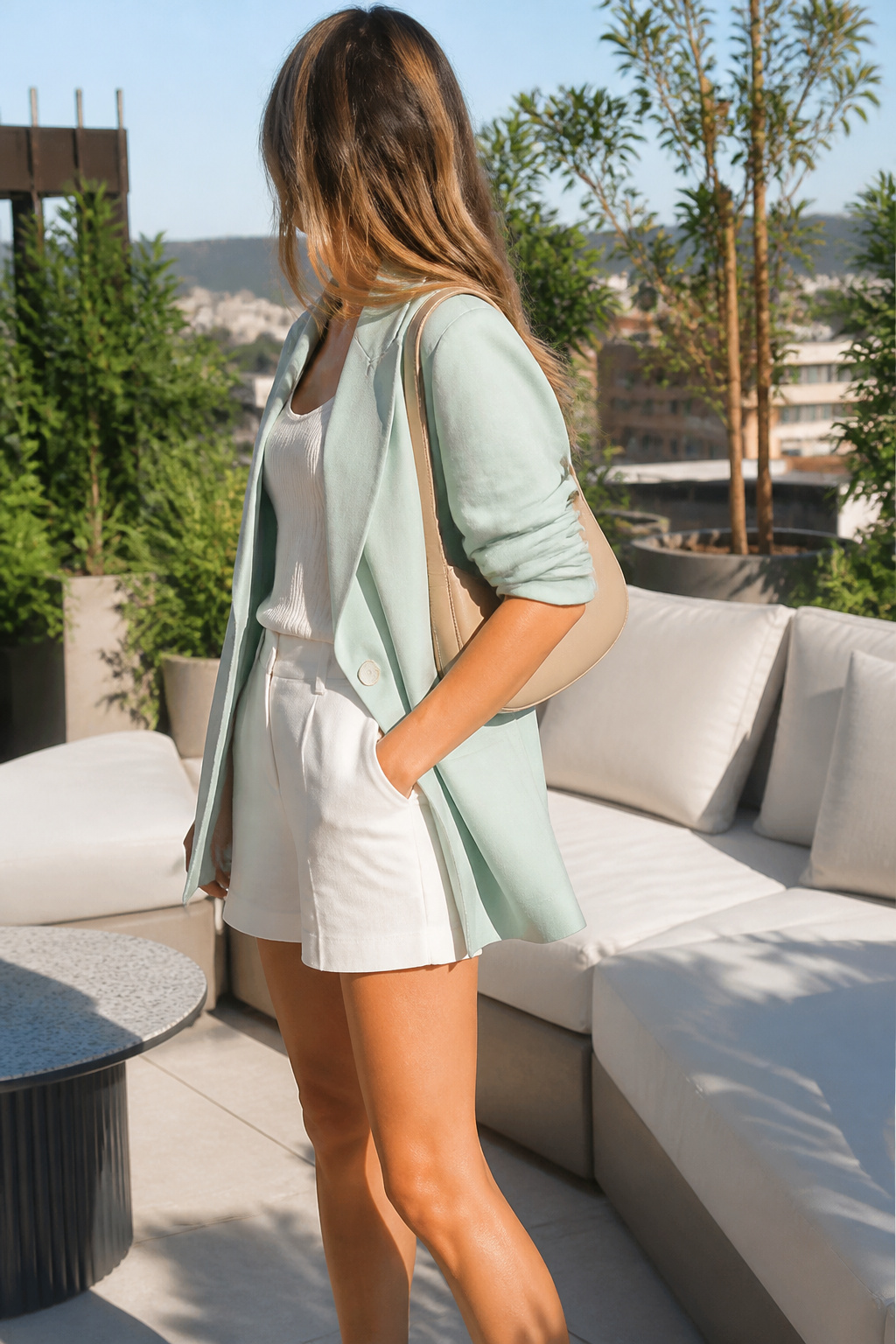
Bare legs with a covered torso handle September’s mood swings better than any other combination I’ve tried. The trick is getting the blazer weight right: mid-weight cotton twill or a lightweight crepe hits the sweet spot, heavy enough to block a sudden breeze but not so insulated that a sunny afternoon turns miserable. Summer linen wrinkles and flaps; winter wool steams from the inside out.
Shorts should stop at mid-thigh to just above the knee — anything shorter looks like you forgot pants, anything longer drags the silhouette down. I learned this the hard way after a full day of tugging at bermuda-length shorts that bunched under the blazer hem. The proportion works because the covered top half reads as intentional, not like you grabbed the wrong jacket. A slim-fit short with a slightly oversized blazer keeps the shape modern; two boxy pieces fight each other.
7. Black Tank With White Skirt
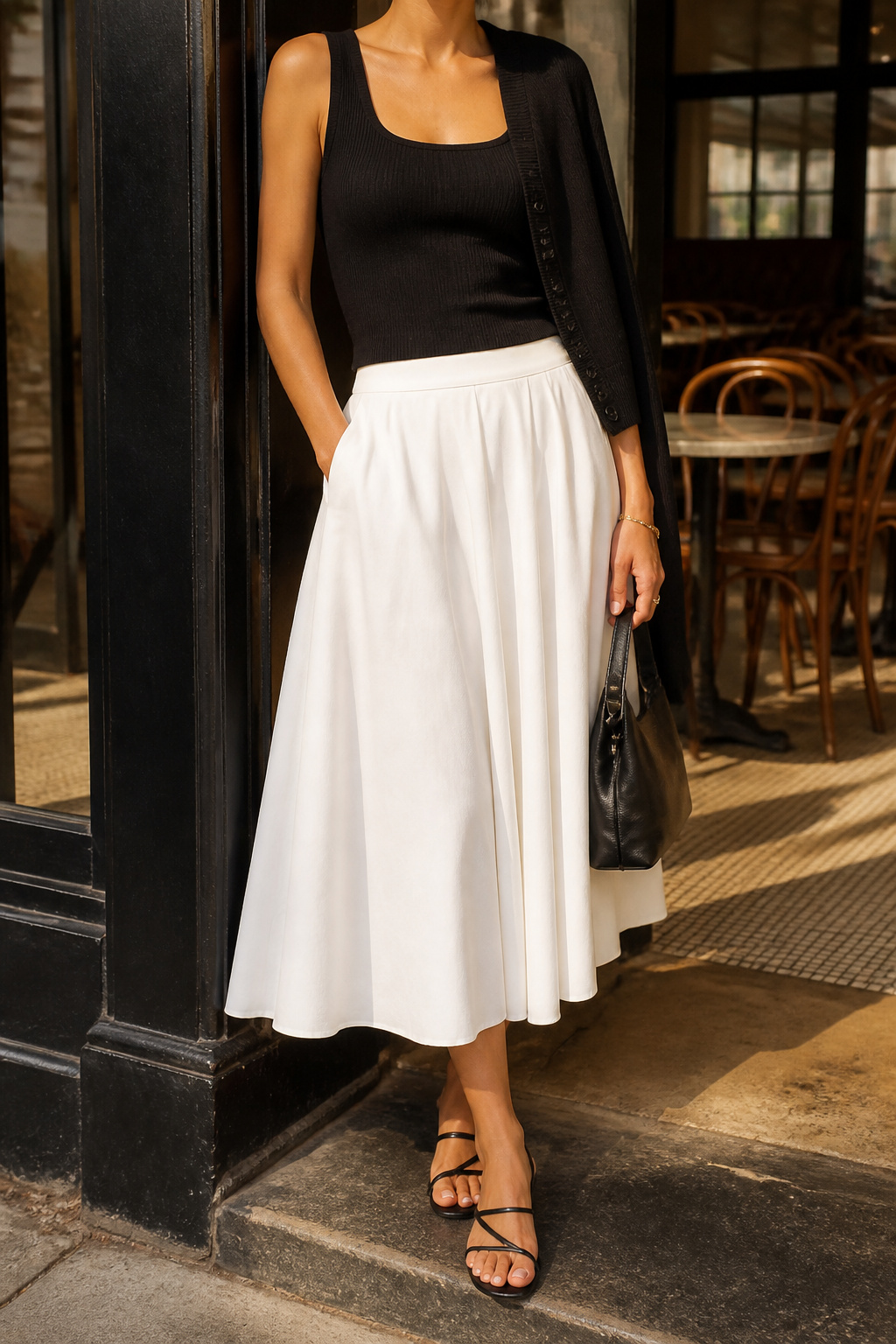
A black tank and white skirt carries the high-contrast pairing that has dominated the last two summers, and September is exactly when it earns its keep as a transitional piece. The black tank grounds the look as the palette shifts darker, while the white skirt keeps enough brightness for the afternoons that still feel like summer. What makes this workable for early autumn is the layering piece you keep close: a fine-gauge cardigan draped over the shoulders handles the temperature drop once evening hits, and the thin knit avoids the bulk that would fight the clean lines of the two-piece. Sneakers keep the whole thing casual if the day calls for walking; swap them for leather slingbacks and the same outfit reads dressed-up without changing the core formula. The mistake to watch for is treating this as pure summer wear and leaving the house without that layer option. September weather shifts fast enough that a tank alone can leave you underdressed by 6 p.m., and carrying a cardigan you do not wear beats shivering through dinner.
8. Fall Color Scheme Outfits
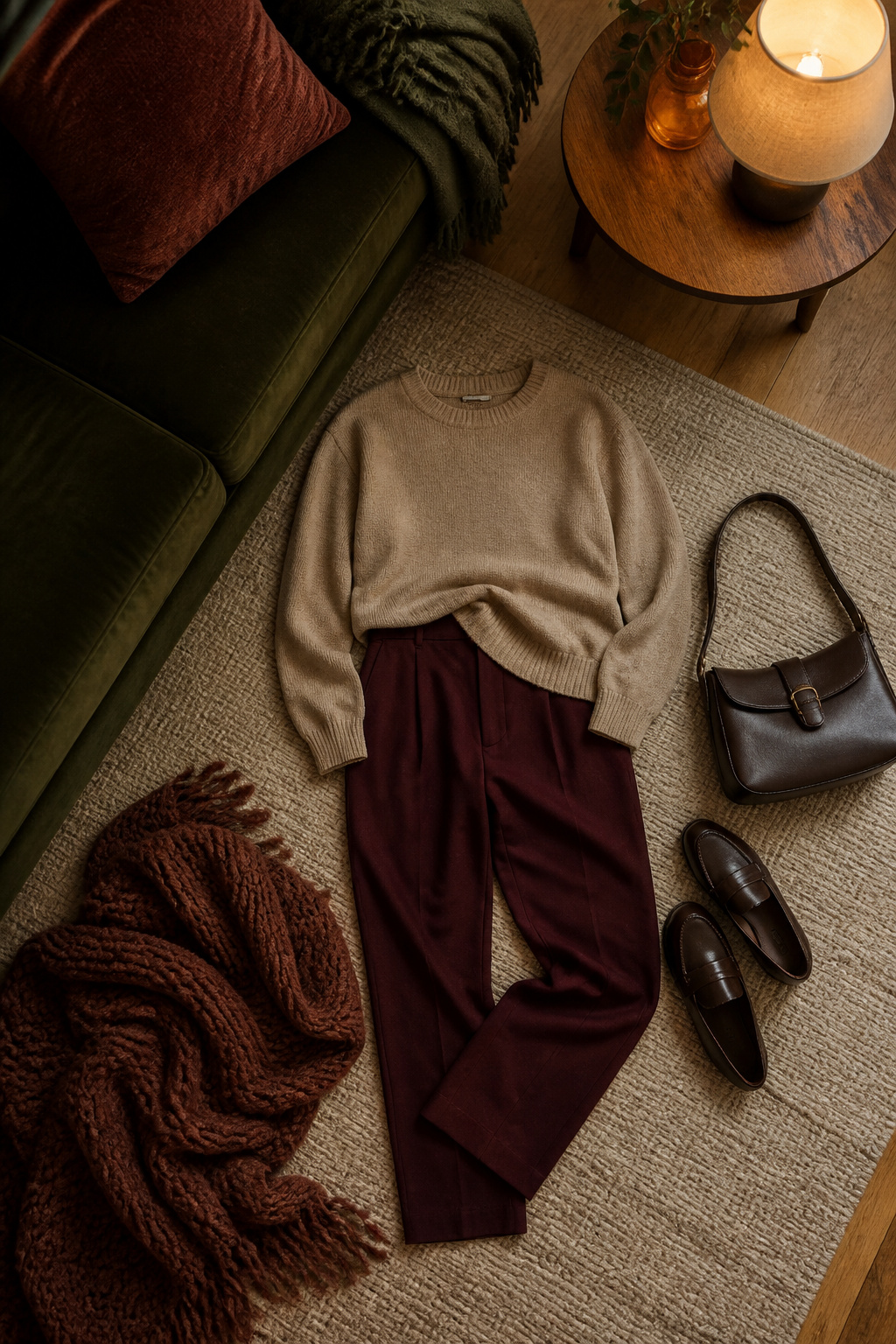
The shift from summer into September is less about one signature color and more about trading pastels for a whole autumn palette: browns, warmer beiges, burgundy or bordeaux reds, and darker greens. That range is what makes the palette workable rather than prescriptive.
Monochrome is the simplest entry point. A beige wool crewneck sweater with matching sneakers, like the Nike P-6000 in Light Khaki, keeps the tone unified without looking flat. Tonal dressing lets you layer two colors from the same family, brown with burgundy touches, or beige drifting into soft pink.
If full color feels like too much commitment, these shades work as accents against your existing neutrals. A burgundy cardigan over black baggy jeans, or a brown blazer with a neutral base, gives the seasonal nod without replacing your whole closet. The leopard print trend noted for September 2025 plays here too, as a belt, sneaker detail, or bolder piece if you prefer.
What convinced me, reading through the styling notes, is how deliberately this shift is framed: not a single prescribed combination, but a palette you can wear as commitment or accent, depending on what your morning allows.
9. Leather Summer Dress With Boots
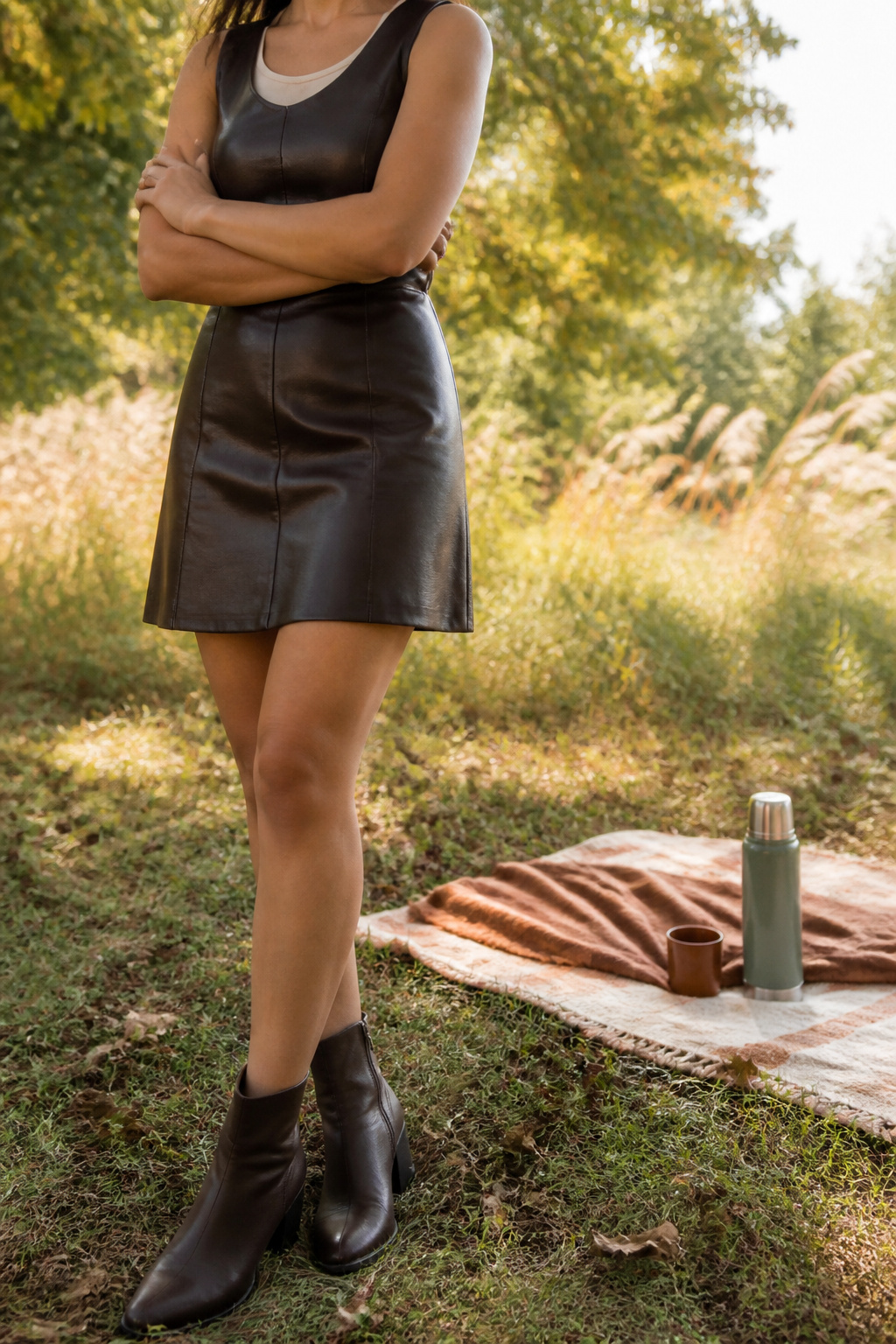
A sleeveless leather dress that felt right in August still has mileage in September. Leather weight handles the shift better than cotton or silk, which go from comfortable to clammy or from airy to insubstantial the moment the temperature drops ten degrees. The same dress gets its second act with ankle boots and, on the cooler mornings, a thin turtleneck underneath. The boots ground the look; the turtleneck adds warmth without the bulk of a full sweater layer. The leather itself does the transitional work, holding body heat when the breeze picks up but never trapping it the way lined fabrics do. I reach for this pairing on days that start at 58°F and promise 75°F by noon, because peeling off the turtleneck at lunch is easier than rethinking the whole outfit.
10. Button-Down With Baggy Jeans
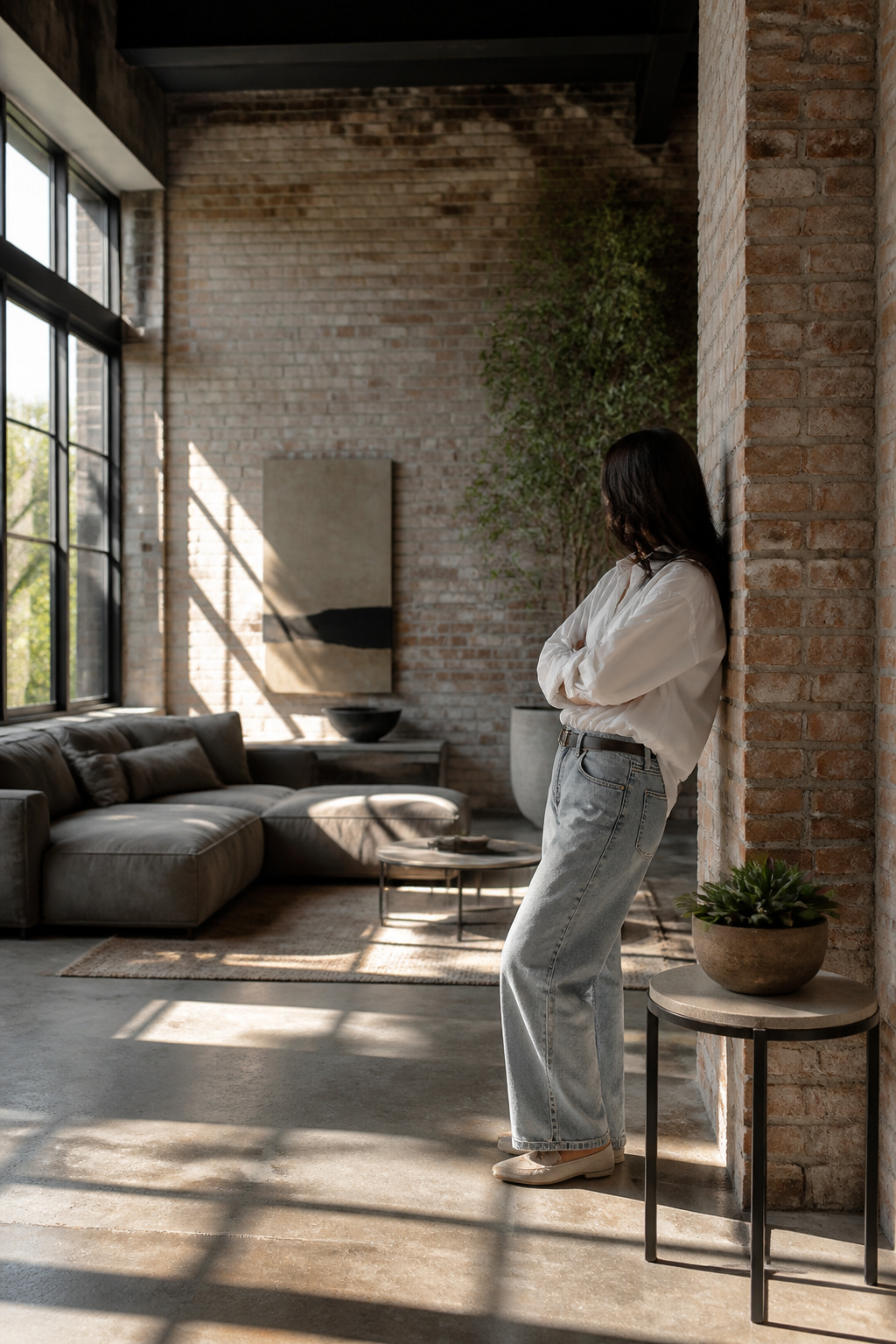
Baggy jeans change the whole equation. The wider leg swallows a standard tucked button-down whole, so the shirt needs to be cropped or hit right at the waistband to keep any shape at all. I learned this the hard way after a morning of looking like I’d stepped into someone else’s clothes; rolling the sleeves to the forearm was the single move that pulled it back from sloppy to deliberate.
The proportion is the point here, not the pieces themselves. A fitted jean keeps your silhouette readable no matter what the top is doing, but baggy denim demands that the shirt do the structural work instead. Lightweight cotton or a thin chambray works best; anything stiff or longline fights the line you’re trying to create.
For September, this pairing handles the temperature swing better than you’d expect. The looseness at both top and bottom traps air without overheating, and you can always throw a sweater over your shoulders if the afternoon cools fast.
11. Tent Dress With Sneakers
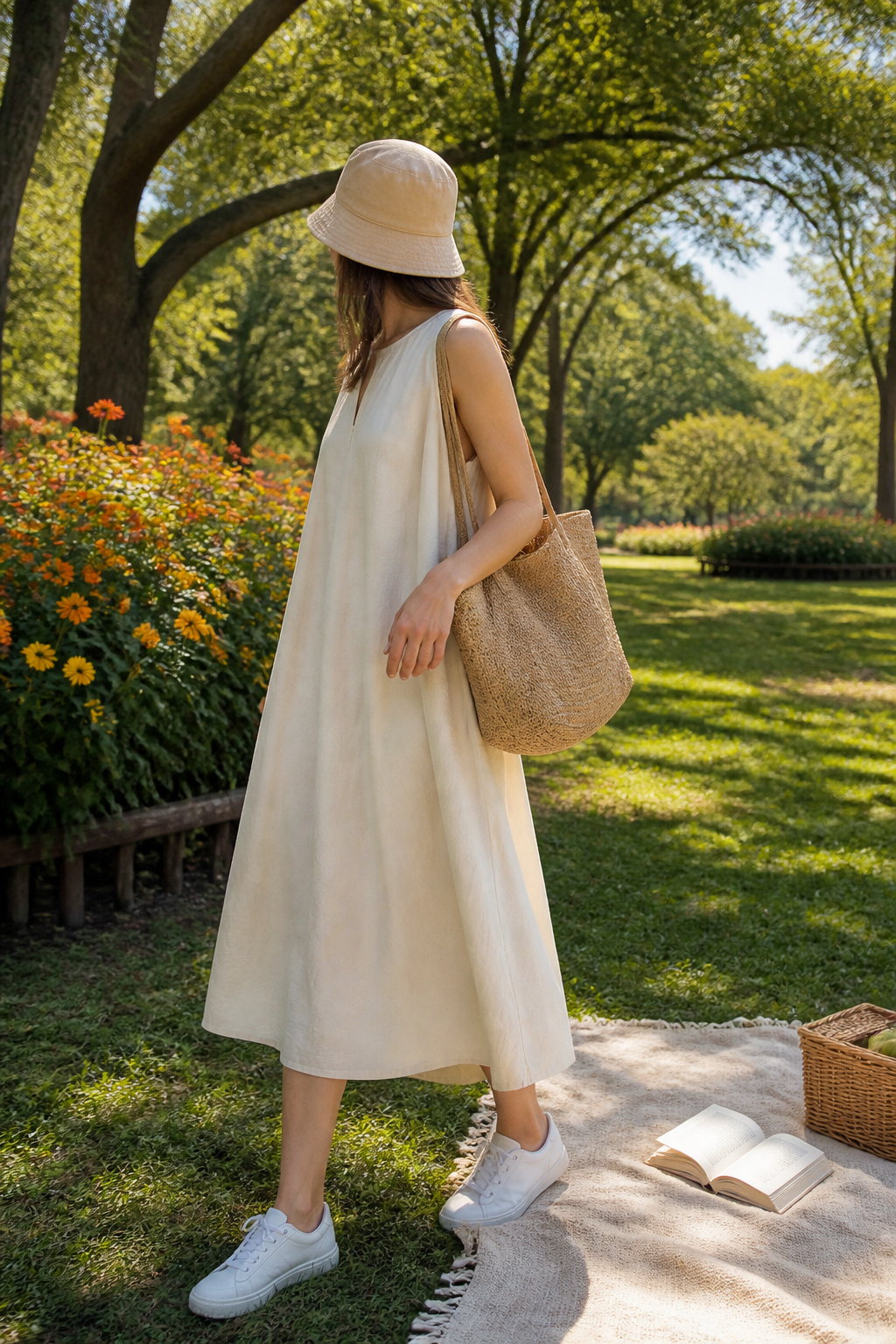
A tent dress in cotton or light wool carries September better than most shapes because the cut does the work. The volume falls straight from the shoulders with no waist seam to fight against, which means a thin long-sleeve layer slips underneath without bunching or pulling the silhouette off balance. White sneakers keep the whole look grounded in something you can actually walk in all day.
The fabric weight matters more than the color here. Early September still holds enough warmth that a heavier knit would leave you peeling layers off by noon, but a crisp cotton or a light wool breathes while it holds the shape. The tent cut also forgives the transitional moment when you are not quite ready for full fall coverage but bare arms feel wrong.
The sneakers should stay clean and simple; anything chunky competes with the dress volume instead of finishing it. A low-profile leather or canvas pair works best, and if the morning starts cool, that long-sleeve layer underneath comes off by lunch and fits in a bag without bulk.
12. Band Tee With Jeans

A graphic tee and jeans is the easiest September outfit to pull from what you already own, but the details make it read intentional rather than leftover from summer. The tee should hit at or just above the waist, either cropped or tucked, so the line of your body shows through the denim. High-waisted jeans do most of the work here; they give the tuck a place to land and keep the proportion from feeling sloppy.
The real move for transitional weather is the open flannel or overshirt worn loose over top. It adds warmth for a 55-degree morning and comes off by noon without disturbing anything underneath. I keep one in my car through most of September for exactly this reason.
Personality comes from the graphic itself, which means this outfit lives or dies by the specific tee you choose. A faded band logo reads differently than a vintage tourist print, and that choice does more than jewelry or shoes to set the tone. The graphic is the whole statement; everything else supports it.
13. Oversized Sweater With Midi Skirt
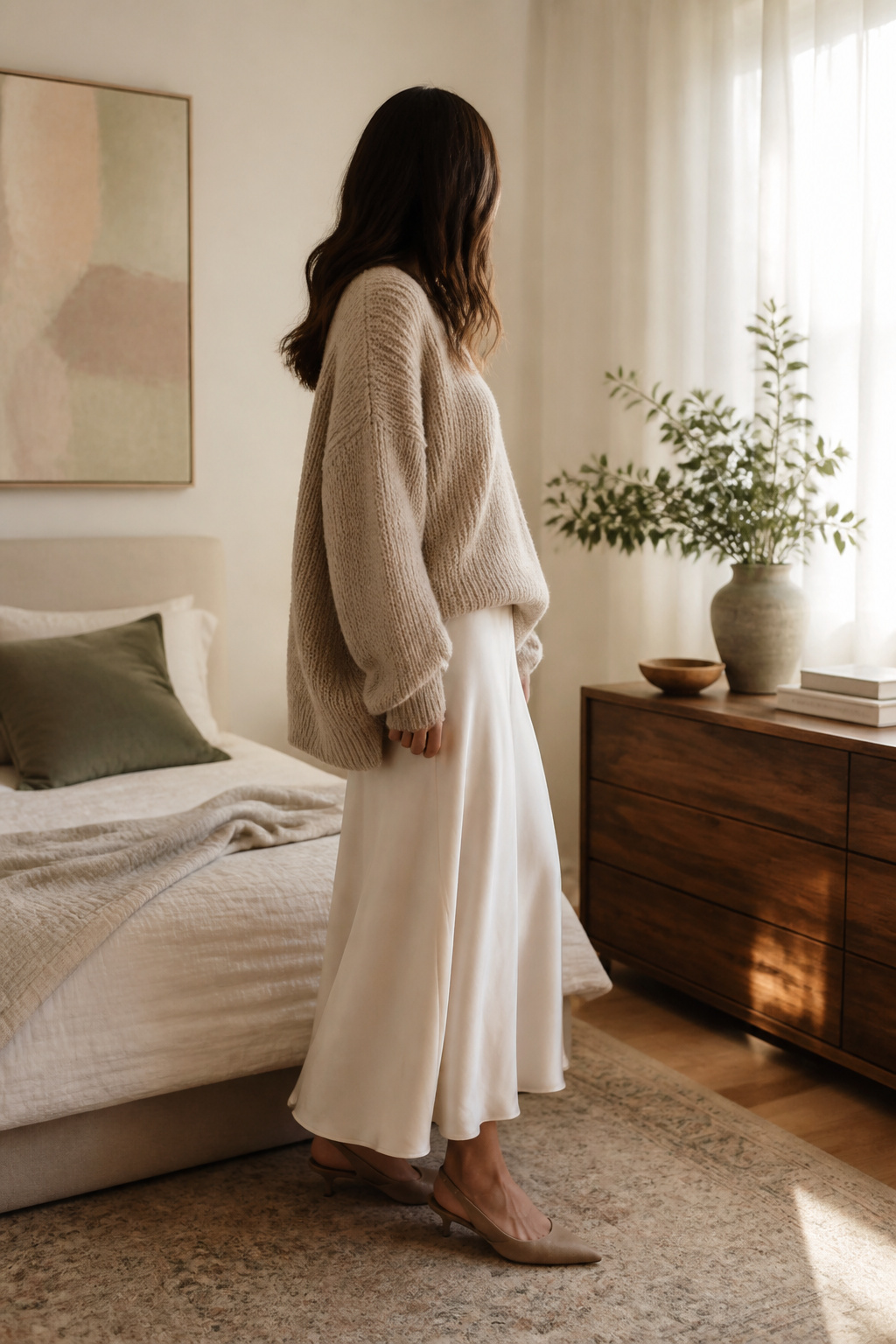
A full knit look reads intentional rather than lazy, and September is the right month to try it before the cold demands heavier layers. The sweater should hit at your hip or below; anything shorter starts looking like you forgot the bottom half of your outfit.
Volume is what makes or breaks the proportion. A very oversized sweater needs a slimmer midi skirt underneath so you do not disappear inside fabric. Silk or a light cotton skims close and keeps the line clean. If the sweater is only moderately oversized, a fuller midi skirt works fine; the slight flare balances the extra room up top without competing.
The skirt material matters almost as much as the shape. Silk catches early fall light and moves well, cotton holds structure for crisper days, and a light wool bridges the gap when mornings are cool and afternoons still warm. I have seen this pairing fail most often when the sweater is both bulky and cropped, leaving an awkward gap at the waist that no amount of tucking fixes. Hip length or longer solves it outright.
14. Rugby Shirt With Micro-Mini
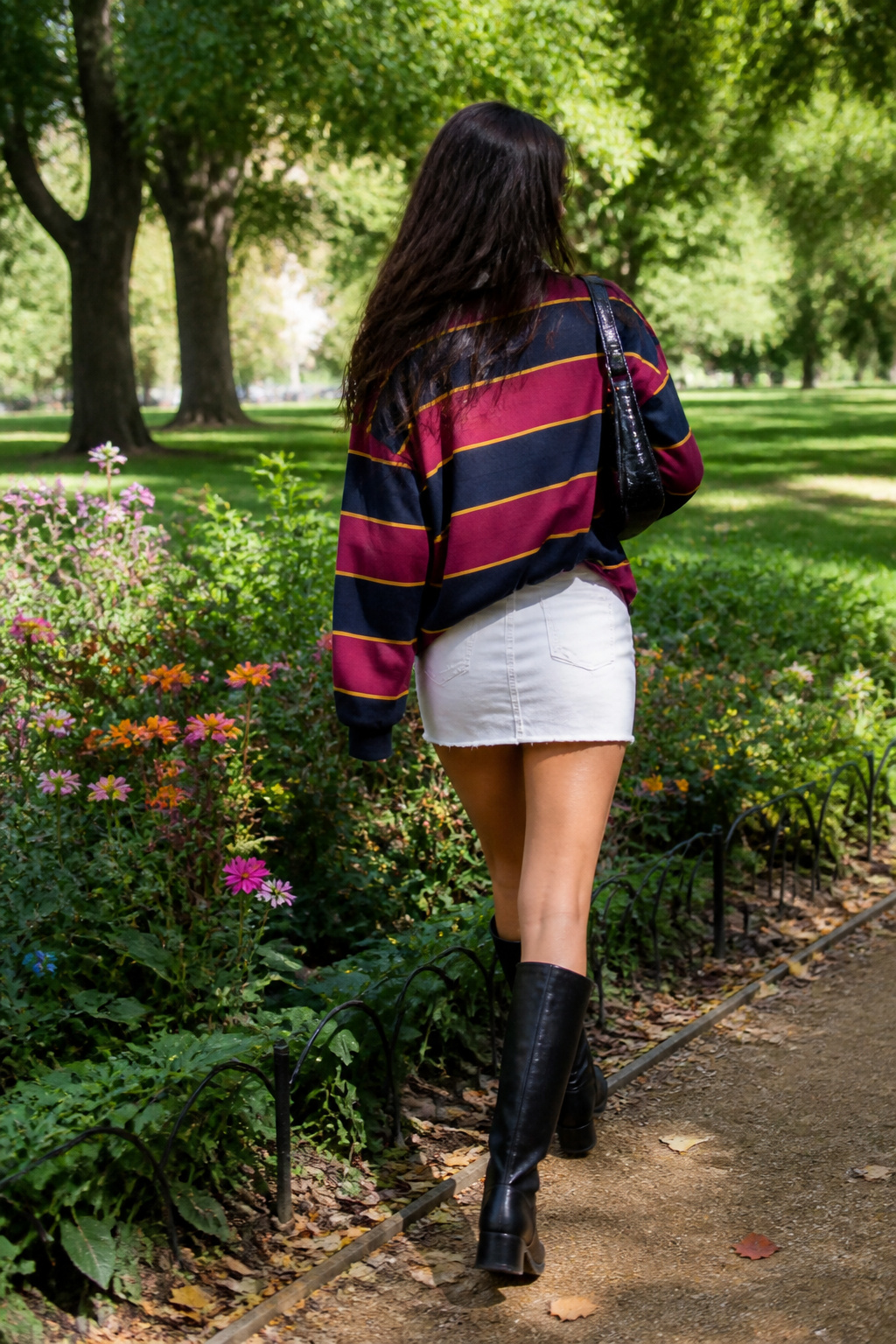
The baggy shirt and micro-mini combination is what pulled me through more Saturday brunches than I can count when the calendar still says summer but the air starts turning. A long-sleeve striped rugby top, usually cotton with those rubber buttons, gives you covered arms while the shortest skirt in your rotation, denim or twill, keeps legs bare. That contrast between top and bottom is what transitional dressing actually means; you are not dressing for one season or the other, you are dressing for the hour of day.
The rugby shirt brings prep sensibility without trying hard. The micro-mini does the opposite of covering up, so the balance works. What convinced me, reading through how stylists build these looks, is that the proportions matter more than the pieces themselves. A skirt this short needs a shirt loose enough to read casual, not calculated. Knee-length boots underneath extend the wear further into fall than flats would, adding coverage where the skirt gives none. The whole thing falls apart if the top gets tucked or fitted; the volume is the point.
15. Plaid Dress
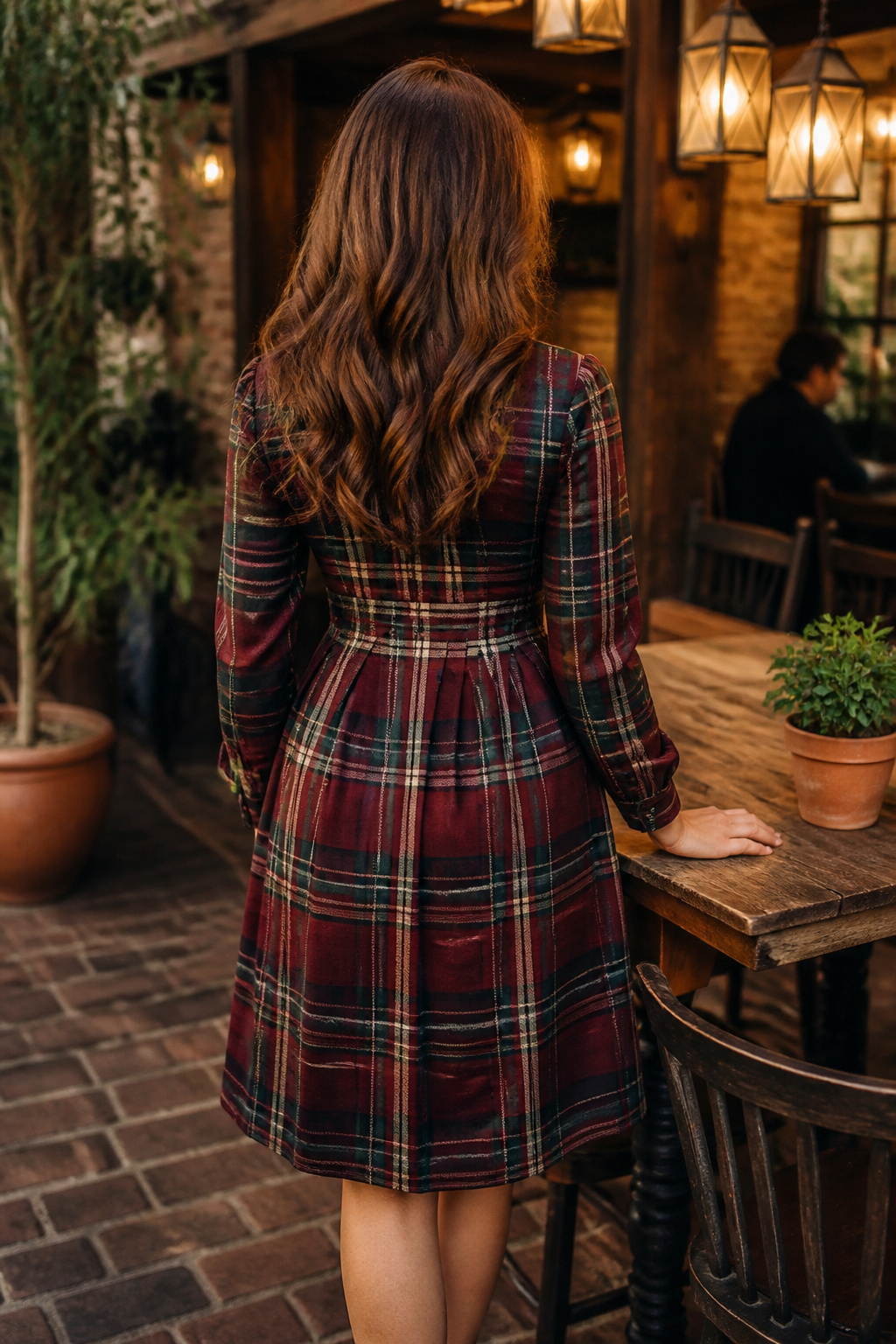
A plaid dress is the single garment that does the most work in September. The pattern alone reads autumn, and the shape can carry you from a warm early-month lunch to a late-month dinner without a full change.
The scale of plaid matters more than most people notice. Windowpane checks read cleaner and slightly more office-appropriate; tartan leans casual and reads heavier even in the same fabric. A shirt-dress cut keeps things relaxed and layers easily over a thin tee if the afternoon still hits the low 80s°F. A fit-and-flare shape traps less heat around the torso but needs more thought with a jacket on top.
Cotton handles early September, when highs sit in the mid-70s to low 80s°F and linen still feels possible. By late month, when highs drop to the upper 60s to mid-70s°F and nights cool further, a wool blend holds structure and actually keeps you warm. The switch point is roughly the third week, though a cotton dress with a light jacket buys you a few extra days.
Leopard print shoes, against the geometry of plaid, keep the look from feeling like a costume. I would not pair another pattern with this one; the dress is doing enough.
16. Breezy Button-Down With Midi Skirt
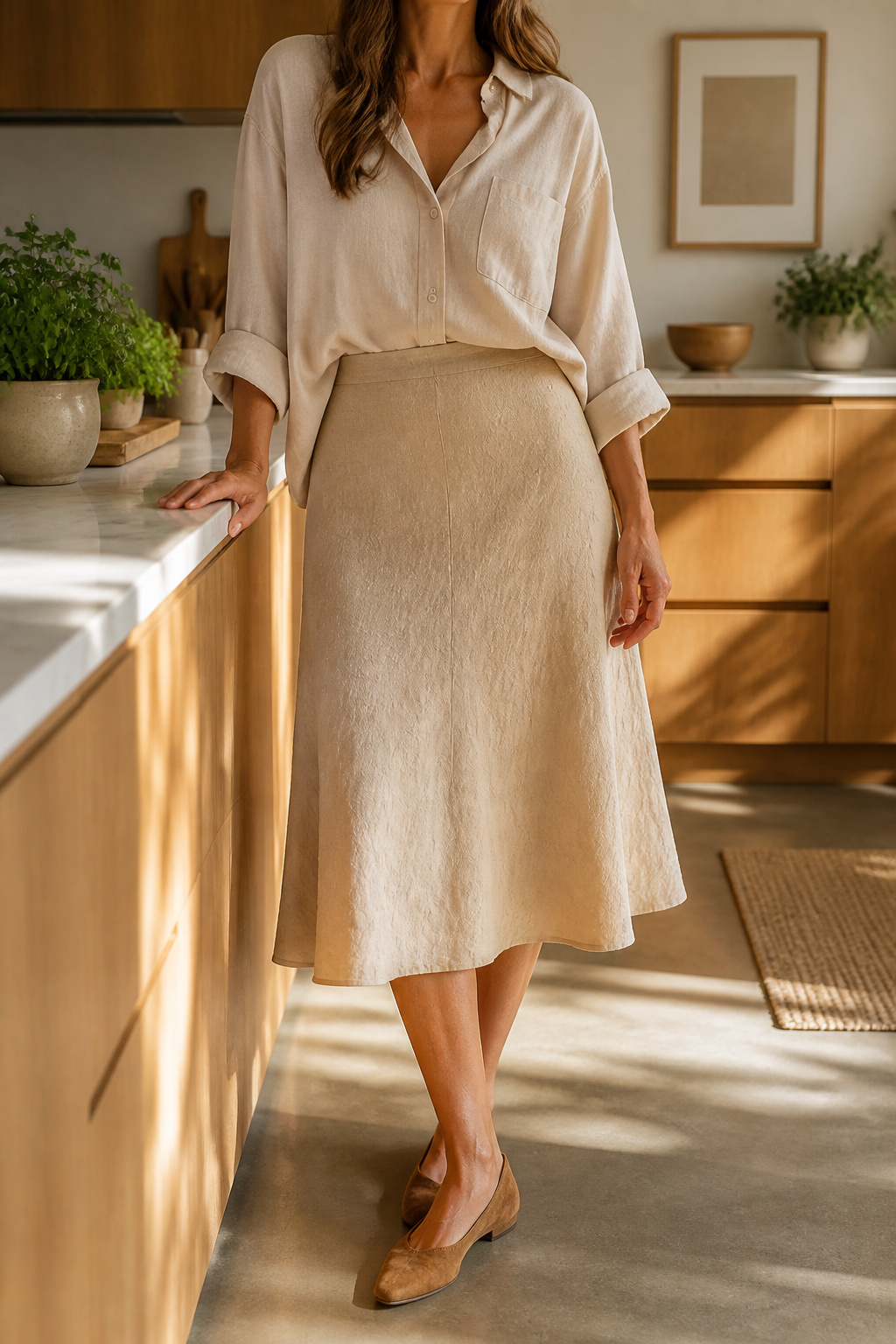
A looser button-down changes the whole equation from the crisp, tucked-in office look. Cotton voile, lightweight silk, or rayon gives the shirt a softer drape that moves when you move, and the skirt should match that energy. An A-line or pleated midi keeps the same easy line rather than hugging straight down. Both pieces skim rather than cling, which matters more than you’d think on days that still hit the low 80s.
Loafers ground the outfit without fighting the flow, though the real win is how little thought it takes once the shapes are right. The shirt untucked or half-tucked, the skirt sitting at your natural waist, and you’re dressed for a morning meeting that runs into evening drinks without the costume-change feeling. The fabric weight is the decision that makes or breaks it; too heavy and the breeze you’re dressing for disappears, too light and the skirt loses its shape by noon.
17. Short Shorts With Long Jacket

A long jacket over short shorts works because September can’t decide what season it is. The pairing gives you coverage where you need warmth and bare skin where you don’t.
The jacket should hit mid-thigh or the knee. Anything shorter looks accidental; anything longer swallows the shorts entirely. I favor running-length bottoms or a true short short, since a longer inseam fights the line of the jacket and turns the silhouette lumpy.
Fabric weight matters more than length here. A cotton twill or lightweight wool jacket gives you actual warmth for morning coffee runs. Denim or structured canvas holds the shape open so you don’t look like you’re wearing a bathrobe. Underneath, a fitted tank or thin long-sleeve keeps the top half from adding bulk where the jacket already lands.
This combination fails when the shorts are loose. Wide-leg or flowy styles create a tent effect with the jacket hanging over them. Slim-cut or tailored shorts keep the proportion deliberate.
The look carries from a 65-degree morning into an 80-degree afternoon without a change. That’s the practical case for it, and in September, practical is what gets worn twice a week.
18. Button-Down With Track Pants
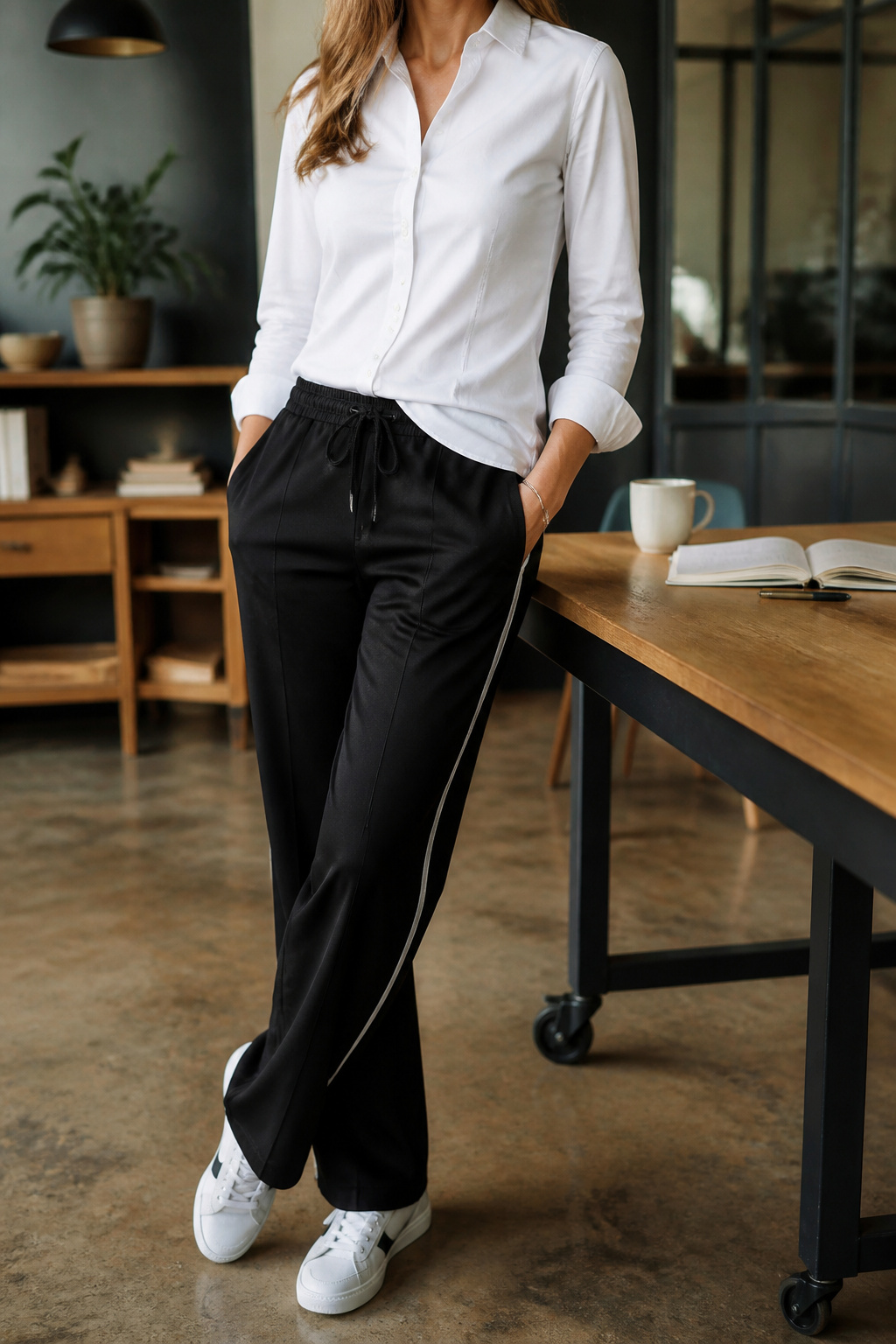
A crisp button-down shirt gives elastic-waist track pants the structure they usually miss. The collar and placket do the heavy lifting here, turning athletic pants into something that reads intentional rather than leftover from a workout.
Technical fabric or cotton pique both work, though they send slightly different messages. Pique has more body and holds the pressed look of the shirt better; technical fabric drapes softer and moves easier if your day involves actual walking. I reach for pique when I need to look pulled-together for a morning that might run into lunch, and the smoother stuff for travel days.
The waistband stays hidden, which matters. A half-tuck ruins this pairing; the whole point is the clean line from shoulder to hip that the shirt creates when it is worn out and buttoned to at least the third button. Leave the last one or two open if you want a little ease through the hips, but do not let the hem bunch over the elastic.
This reads more polished than the same pants with slingbacks and no structured top because the shirt’s architecture does the styling work for you. No jewelry required, though a simple watch or small earrings finish it without competing.
19. Silk Blouse With High-Waisted Jeans

The silk blouse and high-waisted jeans pairing works because the fabrics fight each other just enough. A heavier charmeuse or lightweight raw silk carries the structure September needs; summer chiffon would look like you forgot to check the calendar. Tuck the blouse fully or choose a cropped cut that hits at the waistband so the high rise actually reads as high. Dark wash or black jeans keep the contrast sharp and the whole thing from sliding into weekend territory. I learned this balance the hard way after wearing a pale, floaty silk untucked with mid-rise denim and wondering why the mirror felt off. The weight matters as much as the color. Raw silk in particular has that slubbed, slightly matte surface that photographs well in the lower autumn light without trying too hard. One watch-out: charmeuse wrinkles where the seatbelt crosses, so if you are driving to dinner, drape a cardigan or jacket over your lap.
20. Ruffled Blouse With Linen Shorts

Linen shorts are the last summer fabric that still makes sense once September arrives, especially when the forecast shows highs brushing 80°F. The trick is balancing that airy, rumpled texture with something that reads intentional rather than leftover vacation mode. A ruffled blouse with three-quarter or full-length sleeves does exactly that; the structure and coverage shift the whole look into early fall territory without adding any weight.
Cotton or silk for the blouse gives you the right contrast against the linen’s open weave. Silk catches light differently and dresses the pairing up for dinner outside, while matte cotton keeps it grounded for daytime errands. Either way, the ruffle at the collar or down the placket adds enough visual interest that you don’t need much else. I tend to reach for this combination on those September afternoons that start warm and end with me wishing I’d brought a light layer; the longer sleeves handle the transition better than a tank ever could.
21. Off-the-Shoulder Top With A-Line Midi Skirt

The off-shoulder neckline still earns its place in September because the sun holds enough midday heat to make bare shoulders feel right, not reckless. An A-line midi skirt balances that exposure below the knee, giving you coverage where the breeze has already turned crisp. The proportions work for transitional weather in a way shorts or mini skirts do not.
A ribbed knit top keeps the look casual and stretches comfortably across the shoulders without slipping. Lightweight woven fabrics work too, though they need a closer fit at the band to stay put. For the skirt, cotton poplin holds a pressed shape and moves well with the wider cut; it reads polished without feeling dressed up.
The band of the top should sit snug, not tight, around your upper arms; too loose and you spend the day tugging it into place. Color-wise, pairing a warm neutral top with a deeper skirt shade, burgundy or forest green, starts the shift toward fall without jumping straight to dark layers. Add loafers or ankle boots now, swap to closed-toe heels if the afternoon warms more than expected.
22. Mock-Neck Tank With Wide-Leg Trousers
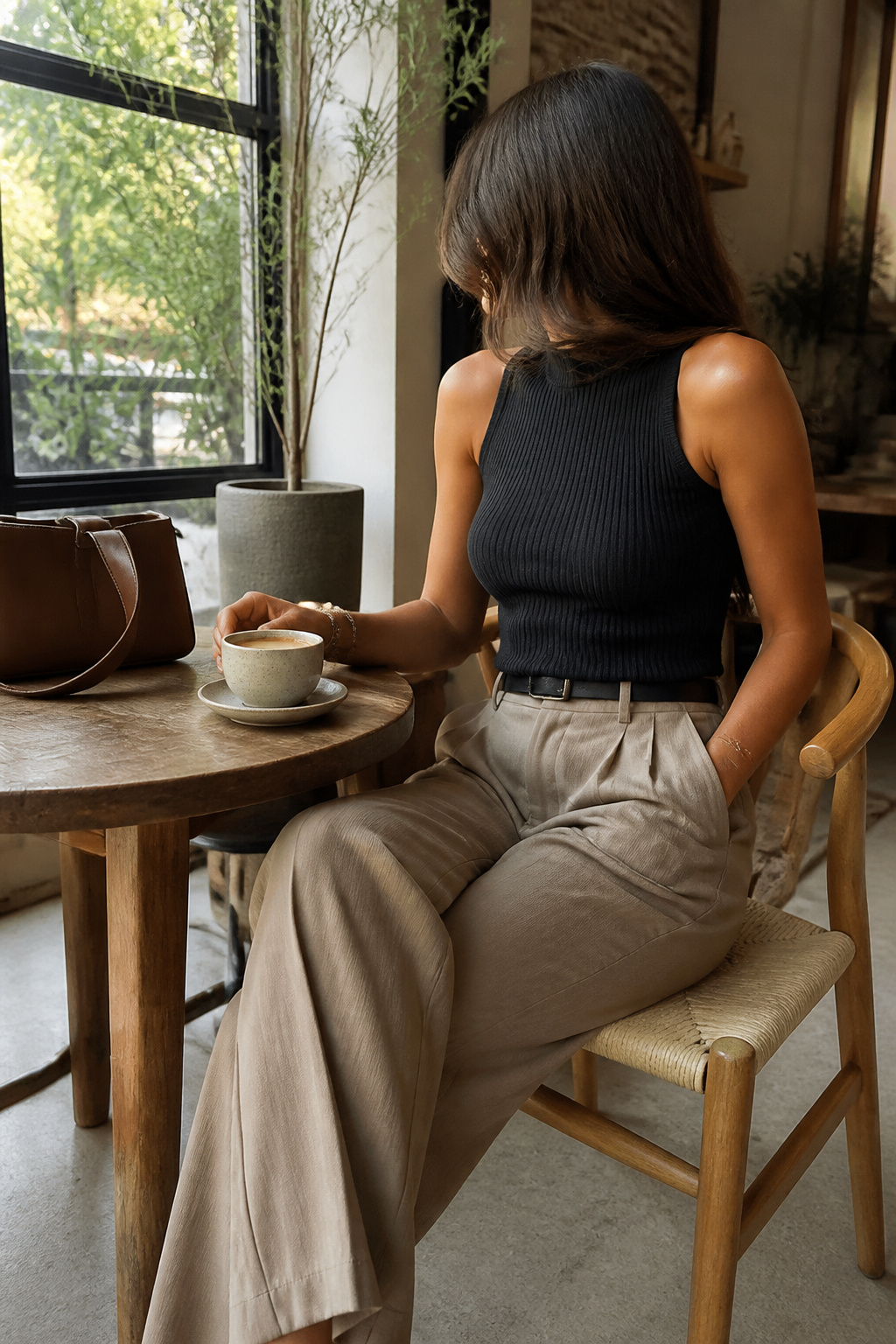
A mock-neck tank hits that strange September sweet spot where the calendar says fall but the thermometer disagrees. The collar gives you coverage without the heat of sleeves, and in a fine ribbed knit or smooth jersey, the fabric sits close enough to layer cleanly later.
Wide-leg trousers balance the fitted top. Crepe, wool blend, or a substantial cotton all work here; the leg coverage reads autumn-appropriate while the cut itself lets air move through. The proportion matters more than the exact fabric. A slim tank against volume on the bottom keeps the silhouette intentional rather than accidental.
This pairing handles the transitional weather directly. You are not pretending it is summer with bare shoulders and cutoffs, nor sweating through early wool. The high neck does the seasonal signaling so the rest of the outfit can stay breathable.
I reach for this combination on days that start cool and climb, or when an office runs cold but the commute does not. A smooth jersey tank in a dark tone with crepe trousers in charcoal or navy reads pulled-together without trying to be a suit. The ribbed knit version, tucked into a wool blend, feels slightly more dressed; the texture does the visual interest so jewelry stays minimal.
One limit: this needs a shoe with some presence. A delicate flat or bare sandal gets swallowed by the trouser volume. A loafer, a low block heel, or a clean sneaker with structure anchors the look properly.
23. Corset Top With Wide-Leg Pants

A structured bodice with a flowing bottom gives the body a clear shape without clinging anywhere. The corset top does the defining work at the waist, and the wide-leg pants take over from there, falling straight to the floor or breaking just at the shoe. Denim, linen, or cotton canvas all hold that waist definition without collapsing into wrinkles by noon, and the pants should match the top in weight so one half does not look like it belongs to a different season.
Matching the fabrics keeps the line clean and almost uniform, like a jumpsuit that happens to be two pieces. A contrast works too, but the eye reads it as more casual, more thrown-together. The architectural quality of this pairing comes from that tension between the fitted upper body and the volume below. It reads as intentional, not oversized for its own sake.
For September, this combination handles the temperature swing better than it looks like it would. The corset layer adds warmth at the core where you need it, and the loose pants let air move against the legs during the warm afternoon. A light jacket over the top turns it evening-ready without hiding the waist you spent the silhouette on.
24. Knit Tank With Denim Skirt
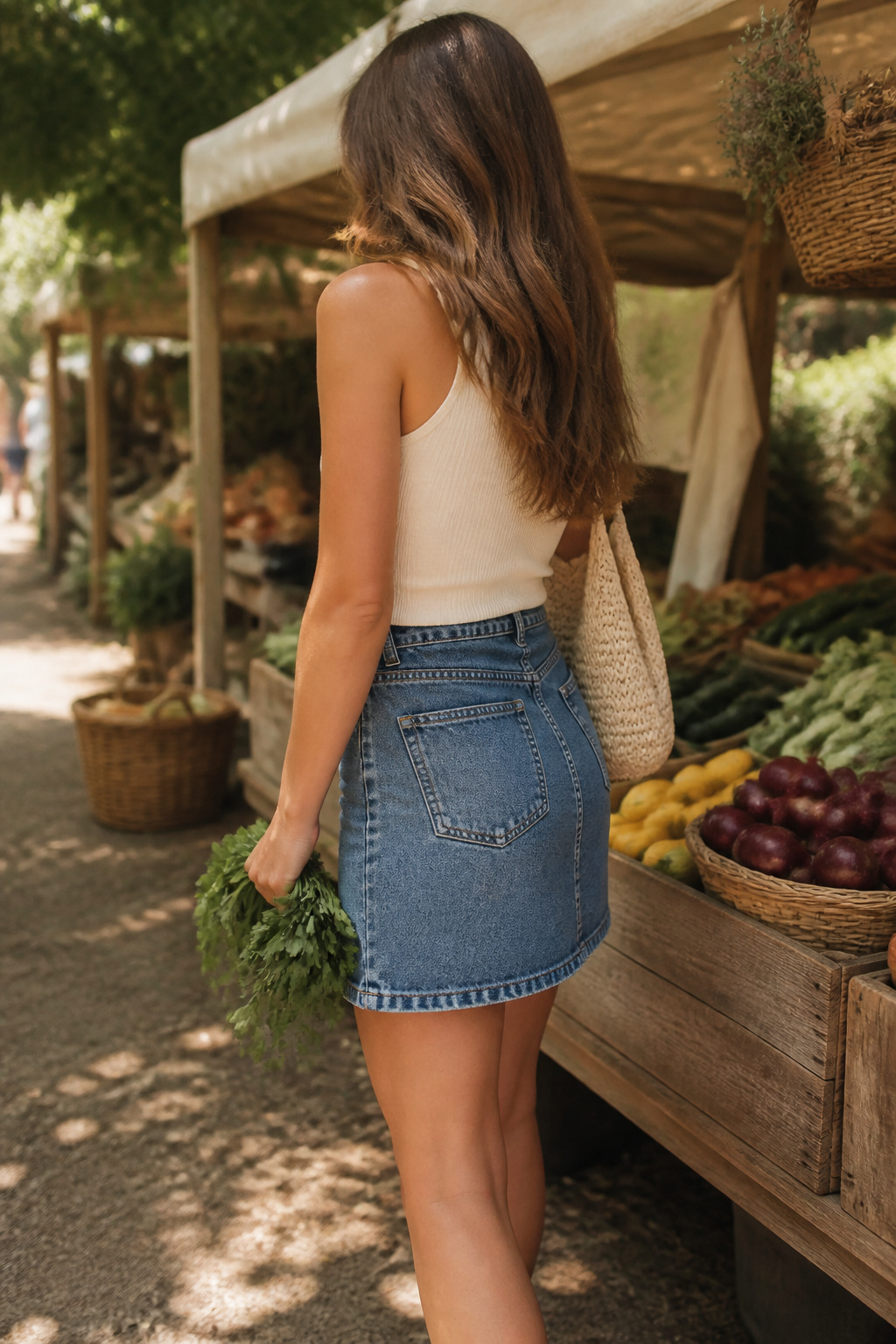
A cotton knit tank against mid-length denim reads like late August stubbornness, but the pairing works for September because the fabric weight is what changes, not the silhouette. I look for a sleeveless knit in fine wool or a dense cotton rib that holds its shape without a lining, then pair it with an A-line or straight denim skirt that hits somewhere between knee and mid-calf. The gap between seasons is where this lives: enough warmth in the knit for a 62-degree morning, enough bare arm to survive the afternoon spike.
The real move is the thin long-sleeve tee underneath. A fitted merino or cotton jersey layer adds coverage without the bulk of a sweater, and you can strip the tank off entirely if the day turns. I tried this once with a too-thick base layer and spent three hours looking like I’d raided a lost-and-found bin; the tee needs to be thin enough that the tank’s armholes still sit flat.
For the outer layer, an oversized utility jacket in cotton or a light nylon bridges the gap when the sun drops. Comfortable sandals carry you through the warm stretch of the month, though by the third week you’ll want suede sneakers in rotation. A canvas tote handles the farmers market run or the commute back to routine. Keep jewelry minimal; the texture of the knit against the denim does enough work.
25. Cropped Hoodie With High-Waisted Jeans
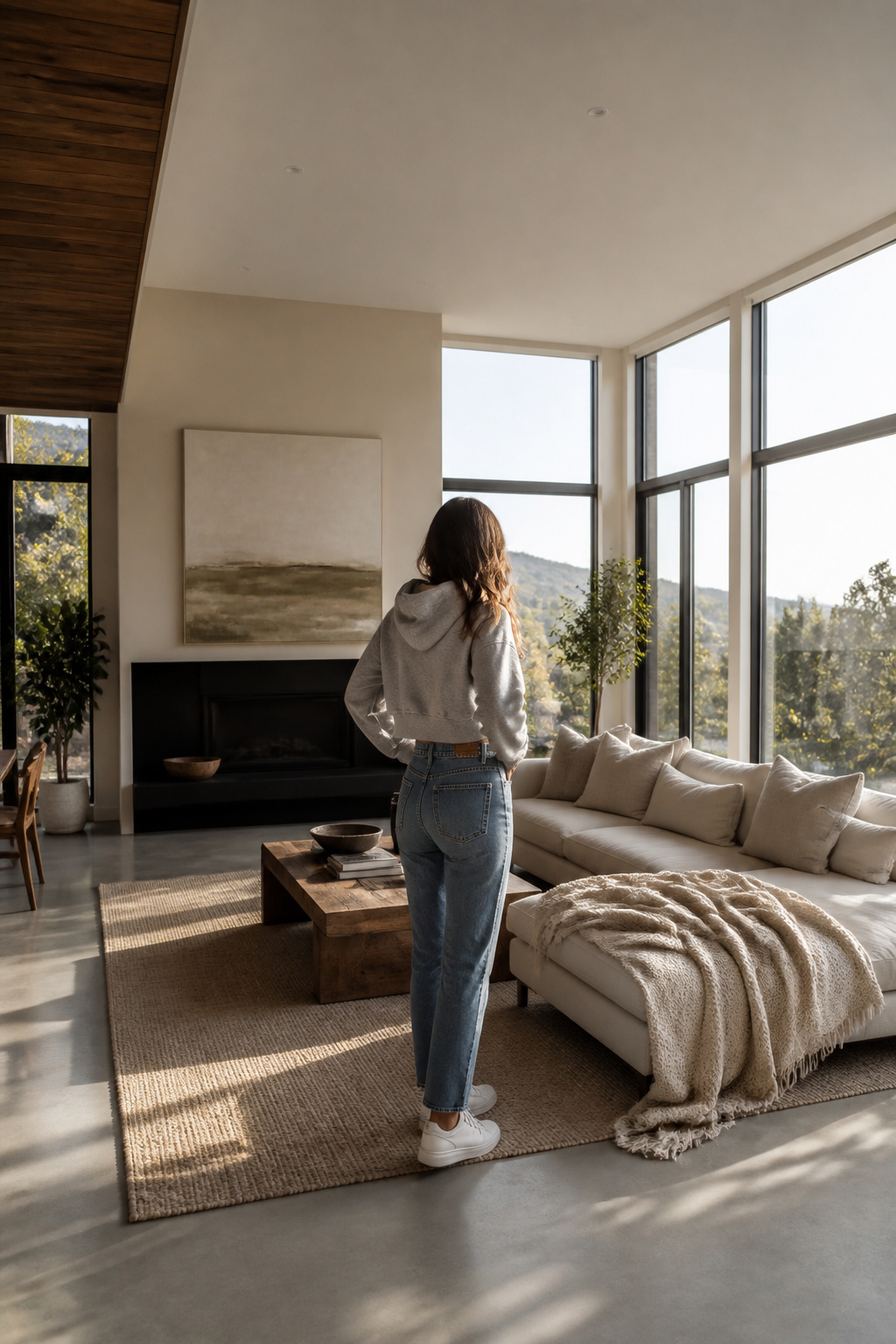
A cropped hoodie works in September because it lets you layer without swallowing your shape. The hem stops two to four inches above the waistband, a gap that reads intentional only when the jeans sit high enough to meet it. Low-rise denim turns that space into a mistake; high-rise, preferably with a rise of 10 inches or more, makes it the point.
Cotton fleece holds warmth for morning chill without the bulk of a full sweatshirt. French terry breathes better if your afternoons still hit the 70s. Either way, the fabric should feel substantial, not gym-wear thin, or the silhouette collapses.
Below, white leather sneakers keep the look grounded and casual. Ankle boots, especially suede or worn-in leather, shift it toward evening. The mistake I see most often is treating the crop as an afterthought: a standard hoodie hemmed up at home rarely falls clean, and the ribbing at the bottom matters more than people expect for holding that measured gap in place.
26. Denim Boilersuit

A denim boilersuit is the most utilitarian piece on this list, and that is exactly why it earns its spot. The workwear shape, a button or zip front with either a belted or straight waist, reads as intentional rather than lazy. Medium to lightweight denim handles September’s swing temperatures without the bulk of winter canvas, and the full-length or cropped pant leg lets you choose how much ankle to show while the weather still allows.
Wearing it alone works for the warmer afternoons. A thin turtleneck or a fitted tee underneath stretches the garment into mornings that start in the low sixties. The single-piece construction means no matching, no tucking, no decision fatigue at 7 a.m.
The straight-waist versions suit a longer torso better; a belted waist can hit at the wrong rib and bunch. If you are between sizes, size up and cinch with the belt rather than fight pulling the zip over hips that sit wider than your waist. That adjustment takes thirty seconds and saves a return.
27. Matching Knit Set

A matching knit set only reads as put-together when the fabric has enough body to hold a shape. Thin, drapey jersey that clings or bags at the knees looks like loungewear the second you step outside. What convinced me, looking through dozens of September outfit ideas, was the difference between a cotton or merino set with a firm gauge and the softer stuff that photographs well but sags by noon.
The safest combination for transitional weather is a cropped cardigan over a fitted tank or short-sleeve tee, paired with a straight skirt or slim pants in the same yarn and exact color. A slight variation in dye lot, and the intentionality disappears. The cardigan should close fully without gaping; worn open, it frames the layer underneath rather than hiding it.
Merino wool handles the temperature swings of early September better than cotton, though cotton breathes more on those last warm afternoons. Either way, the fit at the shoulder and waist is what separates this from matching pajamas. Skip oversized cuts unless the proportion is deliberate: a boxy cardigan needs a trimmer bottom, and wide-leg knit pants demand a shorter, closer-fitting top.
28. Sweater Vest With Flared Jeans
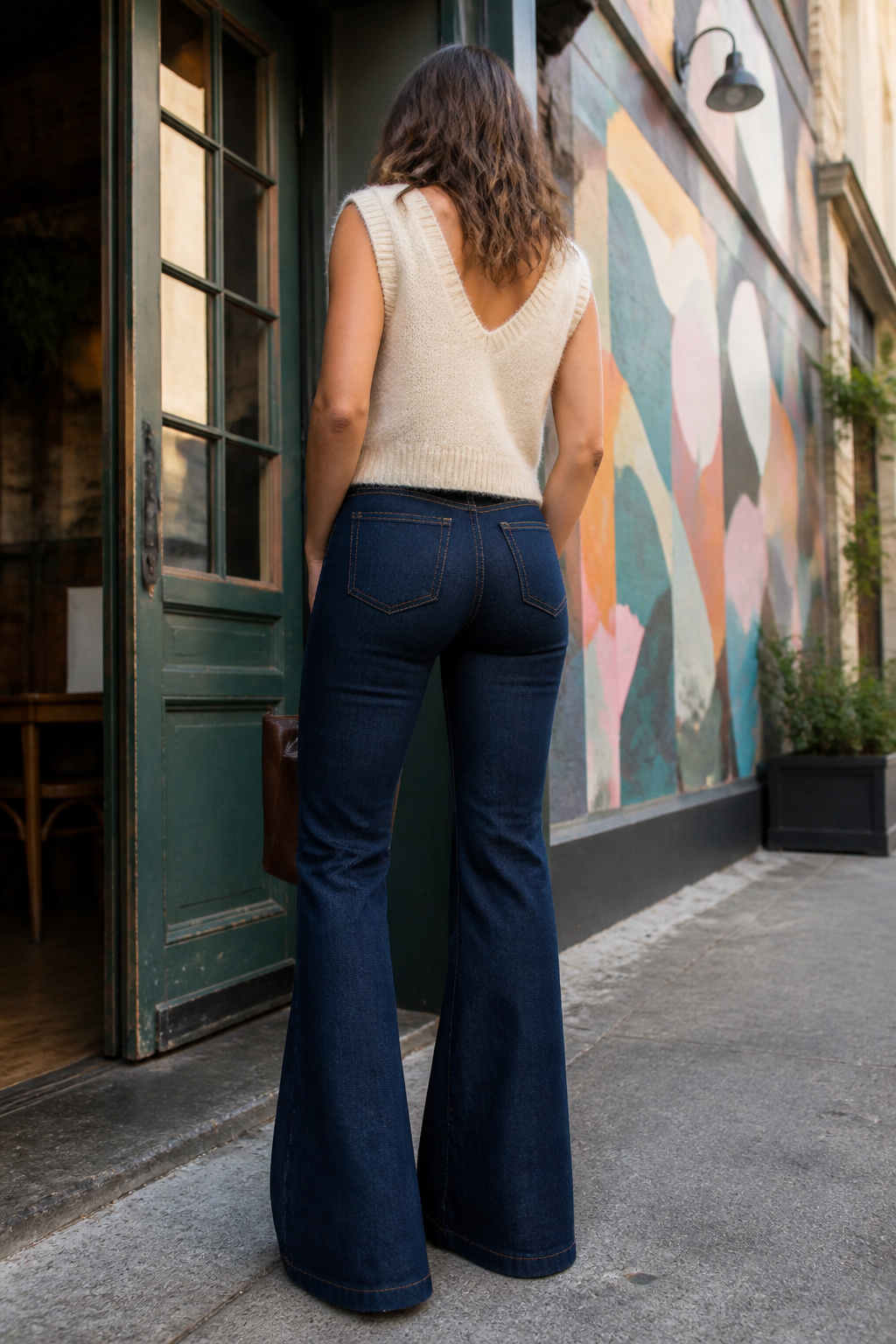
A sleeveless knit vest sounds like something pulled from a nineties sitcom until you wear it solo against bare skin or a tissue-thin tee. The trick is letting it read as a shirt, not a layer begging for a blazer on top. Dark wash or raw denim flares keep the silhouette from feeling costume-y; the 1970s proportion is there, but the color and weight feel current.
The vest puts warmth right at your core while September mornings still let you leave arms uncovered. Flared jeans starting to widen from the knee down balance the cropped or boxy line most vests hit. Babaton’s Emporia Sweater Vest runs $110, and American Eagle’s Ne(x)t Level Flare lands at $50 if you want to test the pairing without a heavy outlay.
29. Chunky Jewelry With Tailored Staples
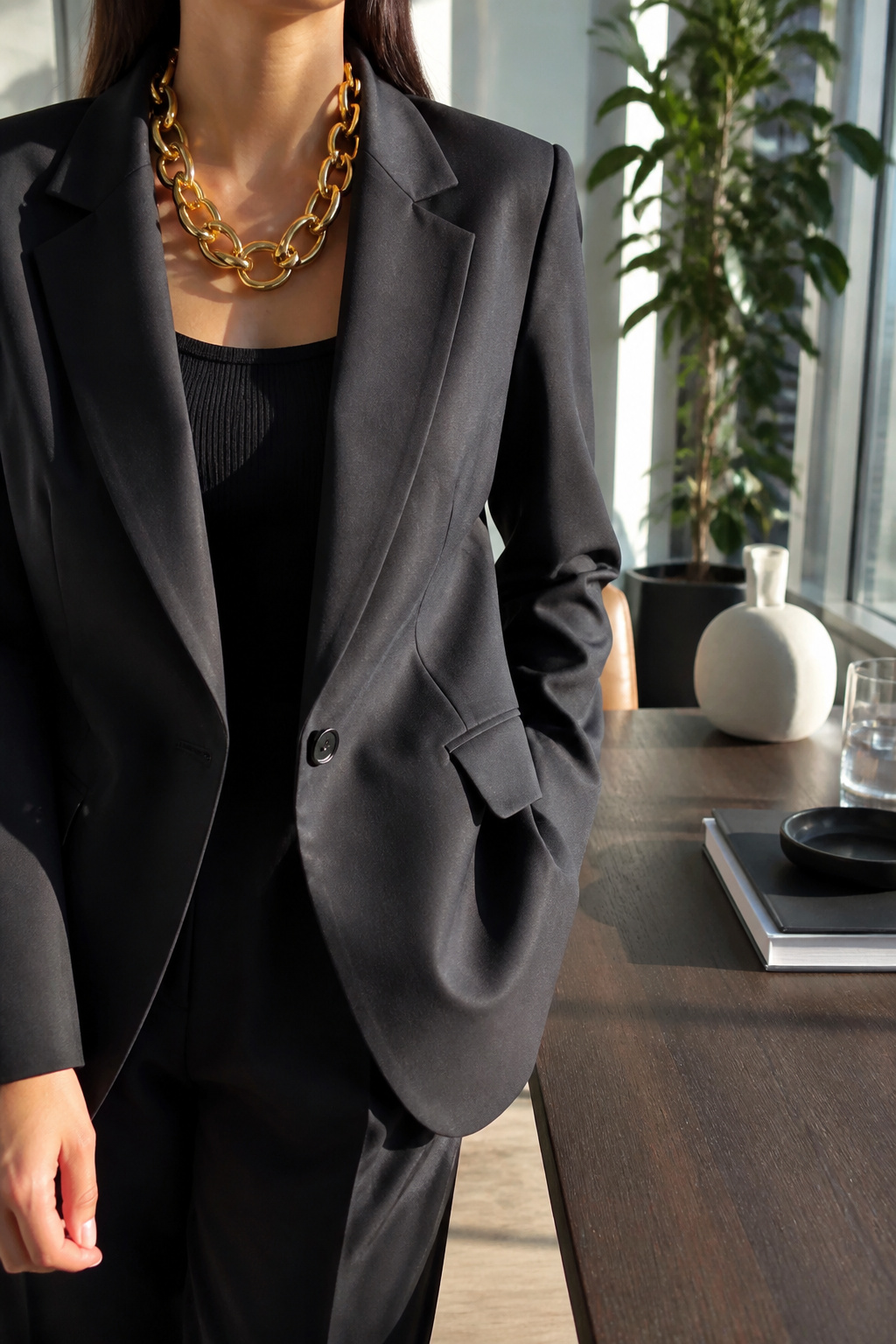
A sharp blazer reads all business until you layer on a heavy chain necklace that catches the light every time you turn your head. The contrast is what makes it work: the tailoring keeps the jewelry from looking costume-y, and the jewelry keeps the tailoring from looking like you forgot to change after the meeting. I like an oversized gold chain against something structured, like a sheath dress or straight-leg trousers, because the clean lines underneath give the piece somewhere to land.
Sculptural earrings do the same job with less weight around your neck. The sources point to two directions here: pile on multiple chunky chains for a deliberate weekend feel, or let one standout piece do the lifting against a simple black dress. Both approaches share the same rule. The jewelry has to be the only statement in the room. Add competing prints or a second bold accessory and the eye has nowhere to rest.
For a starting point, the Everlane ’80s Blazer at $175 and Mason & Madison Co. Chain Necklace at $85 (currently marked down from $125) give you the bones of the look without a huge outlay. The AUrate x Kerry Lioness Necklace at $550 is the upgrade if you wear this combination often enough to justify cost-per-wear. The mistake I see most often is treating the chain as an afterthought tossed on at the door. Put it on while you’re still deciding the rest, and let the scale of it guide how simple the outfit underneath needs to be.
30. Layered Blazers

Wearing two blazers at once sounds like a mistake until you see the proportions land right. The outer layer needs enough room across the back and through the sleeves that the inner jacket never pulls or bunches; shoulder seams on the inner blazer should sit a half-inch or more inside the outer one’s edge so neither fights for space. Lightweight fabrics keep the whole stack from turning into a sauna, which matters in September when the afternoon still warms up.
Color is where you make the choice deliberate. Tonal pairings, like camel over tan, read as one rich shape. Contrasting works too, but one patterned piece against one solid keeps it from looking like you got dressed in the dark. A Treasure & Bond patch-pocket blazer at $99 over something simpler in a solid hue gives the idea without the chaos of competing prints. The inner layer can be a shorter cut or a different lapel style, so long as the collar lies flat and the sleeves of the outer blazer fully cover what’s underneath.
Layering for Temperature Swings
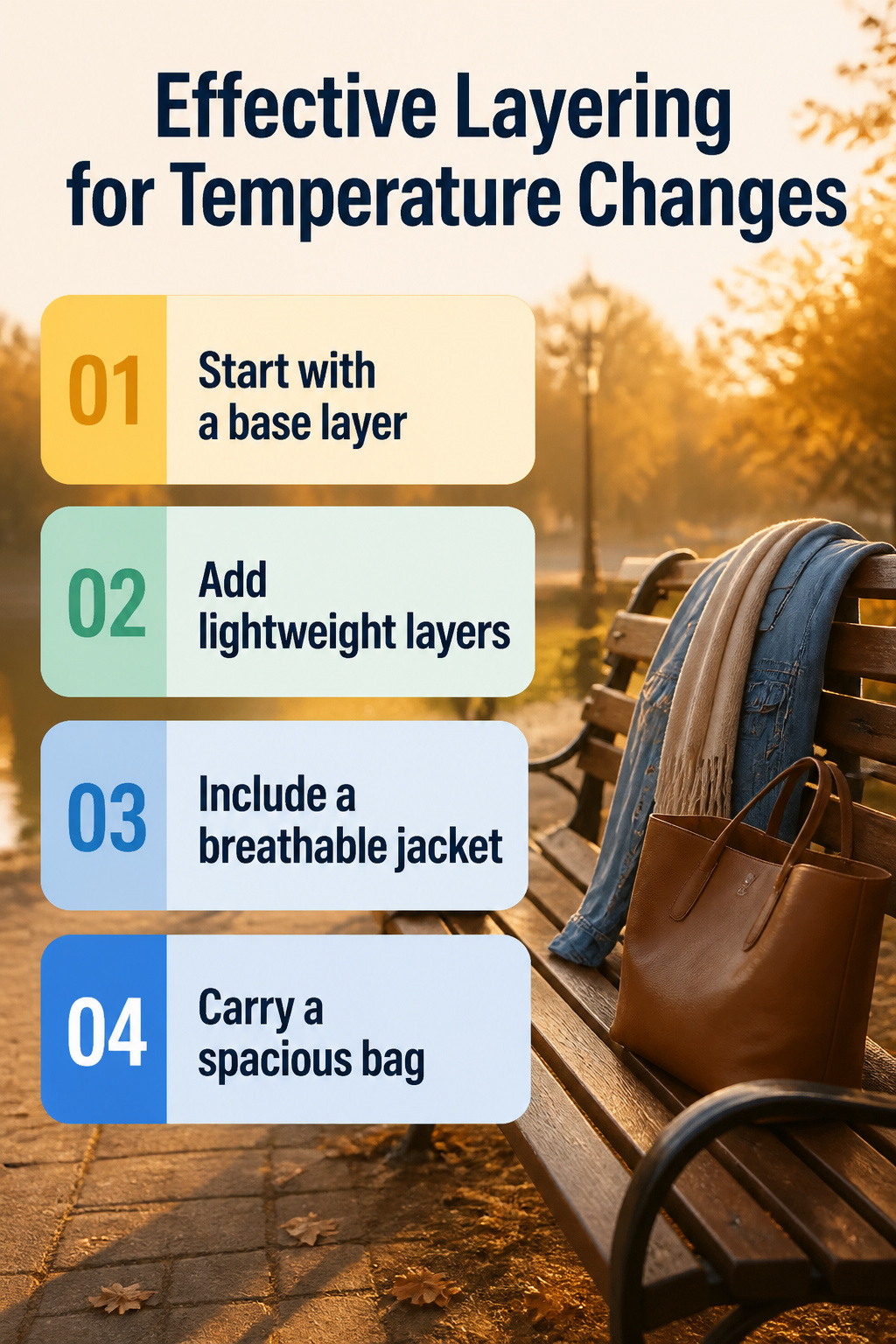
September afternoons in the mid-70s°F still feel like summer, but once the sun drops, low 60s°F evenings demand a quick change. The base layer has to work alone if you end up carrying the rest. A cotton or light knit shirt handles that shift without looking like you stripped down. Cardigans, lightweight jackets, and scarves come off in the afternoon heat and go back on after dinner. Cotton, denim, and breathable blends move air while you are warm and trap enough when you are not. The technique is simple: build from something you would wear at the warmest point, then add pieces you can lose without ruining the look. A bag big enough to hold the shed layer keeps your hands free. This approach runs through most September outfit ideas because the temperature swing is the one thing you can count on.
September Fabric Weights
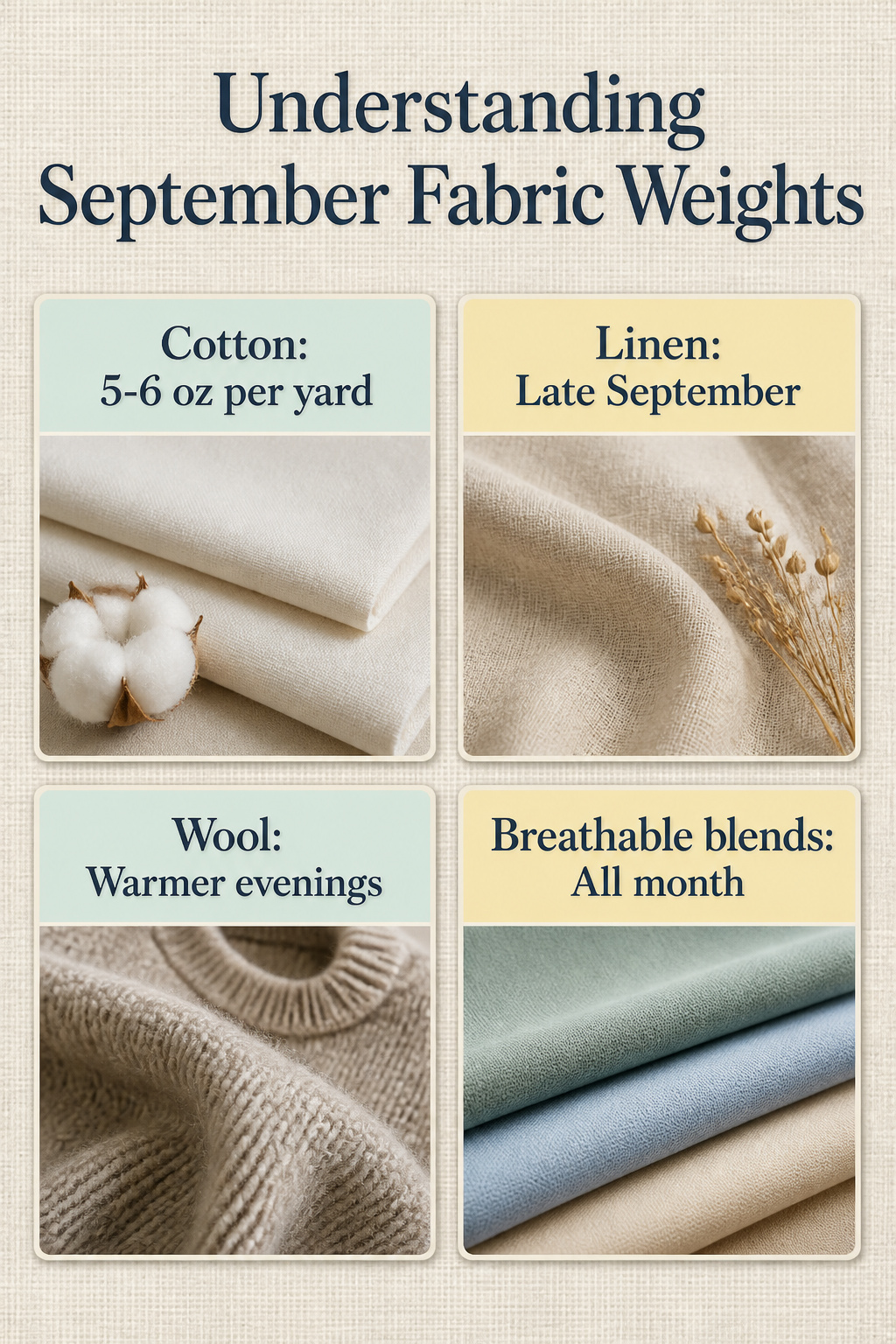
Cotton, denim, lightweight knits, and breathable blends carry most of September. Early in the month, linen still works for those last warm afternoons in the mid-70s to low 80s°F range. By late September, when highs drop into the upper 60s to mid-70s and nights cool further, wool starts earning its place in the rotation.
Reading fabric weight on labels takes practice. Hold the bolt or garment in hand: a mid-weight cotton around 5–6 oz per square yard feels substantial enough for layering without bulk, while a lightweight knit at 3–4 oz drapes differently and chills faster after sunset. A quick pinch test tells you whether a fabric will stand alone or needs backup; if light passes through the weave easily, plan to pair it.
The transition is not a switch you flip. A wool-blend crewneck sweater layered over a cotton tee handles the swing from a 75°F afternoon to a 55°F evening better than any single heavy piece. Synthetic fibers like nylon have their place too, especially when occasional showers hit and a water-resistant layer saves the outfit. The material knowledge matters more than the trend: a trench in breathable cotton gabardine works across more temperature swings than a heavier coat in the wrong weight for the date.
Footwear That Walks
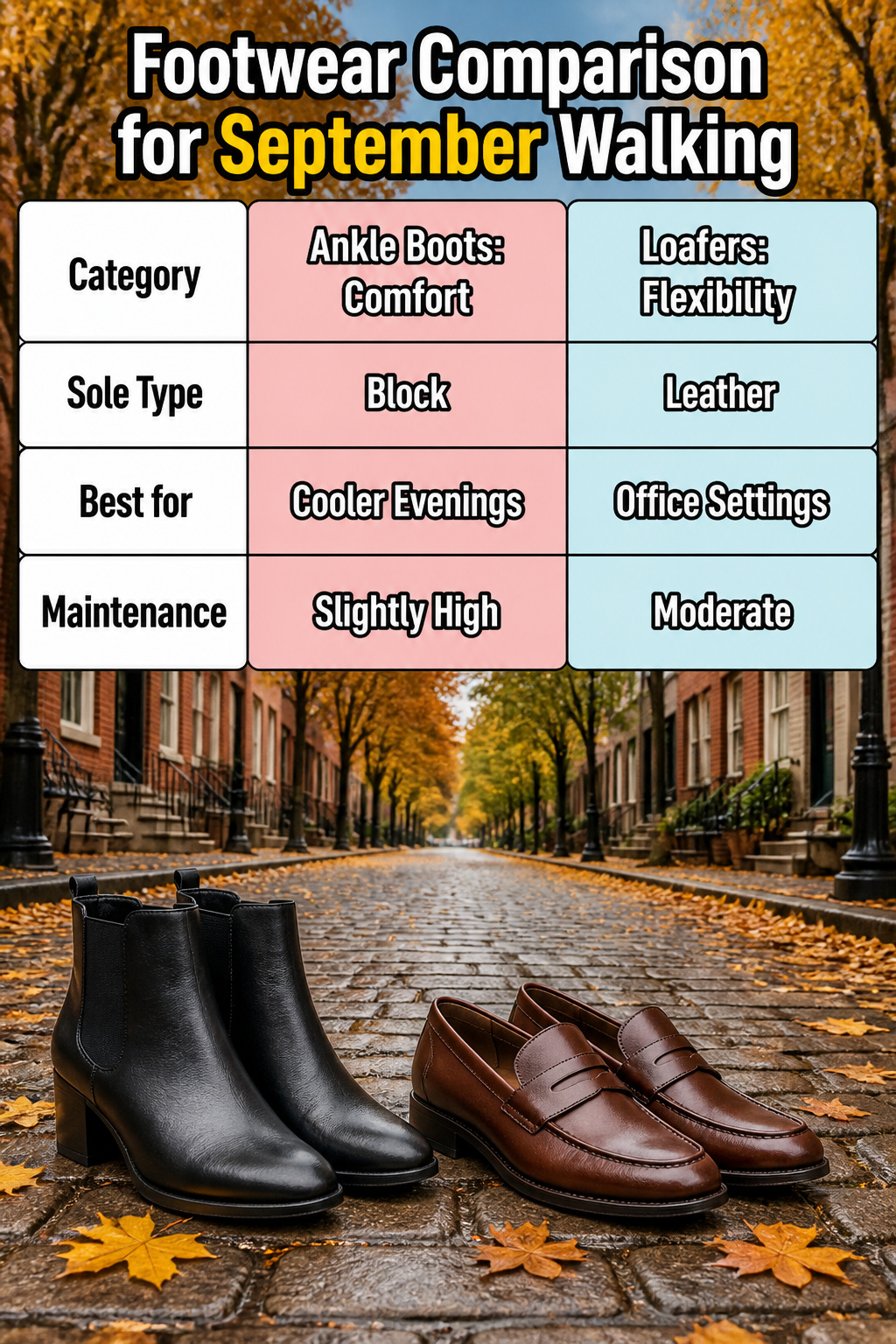
Ankle boots, loafers, and white sneakers are the three styles that come up again and again for September city walking, and each one solves a different problem the month throws at you.
The boot height matters more than you’d think. An ankle boot hits right at or just above the ankle bone, which is enough coverage for cooler evenings without the heaviness of a taller shaft. Block heels get mentioned specifically for comfort on pavement, and that checks out: the wider base distributes weight better than a stiletto when you’re covering real distance. Early September can still throw warm afternoons at you, so boots work best for the back half of the month or for dressier outings where sandals feel wrong.
Loafers win on sole flexibility. A loafer that bends at the ball of the foot lets your natural walking stride stay intact, which matters when you’re logging miles between meetings or museums. The smart-casual polish means they bridge workwear and weekend better than sneakers do, though they give up some ground on rainy days. Leather soles look refined but can be slick on wet pavement; a rubber sole or a top lift adds grip without killing the silhouette.
White sneakers are the clean slate that goes with nearly every September outfit idea, but the maintenance is the real commitment. One rainy afternoon splashes mud up the sides, and the whole point of the shoe turns dingy. Water-resistant treatments help, and some brands now make sneakers with water-resistant uppers specifically. The sources mention breaking in new shoes before a trip and adding cushioned insoles for all-day wear, which applies across all three categories but especially here: sneakers tempt you to walk farther than the factory insole was built for.
Rain boots or water-resistant sneakers are the backup plan the sources keep circling back to. September precipitation is unpredictable enough that a shoe that can handle wet pavement without looking like gear changes what you can do with your day.
Color Shift for Autumn
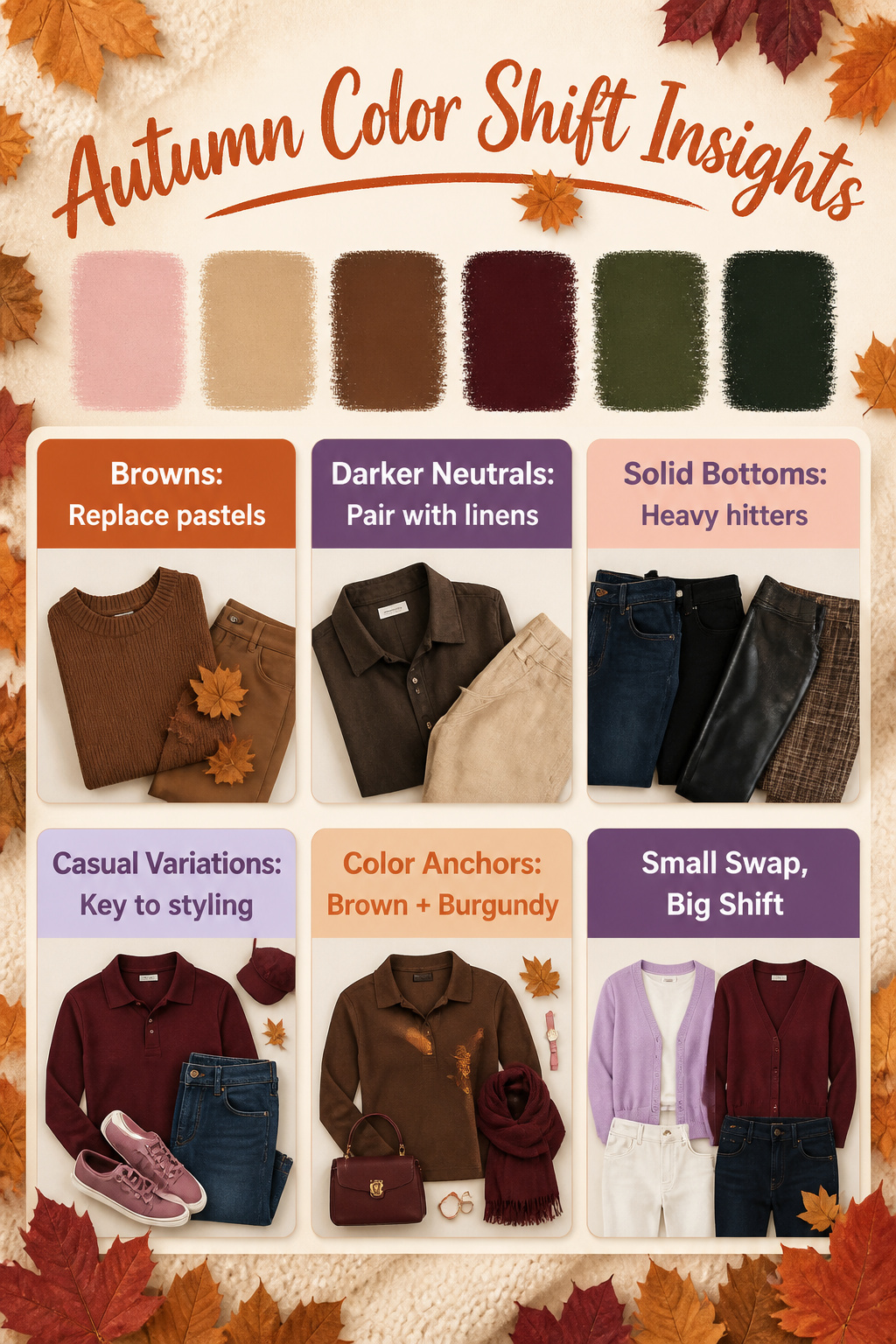
The shift from summer into September color happens in stages, not all at once. Pastel tones fade first; what replaces them is a palette of browns, warmer beiges, burgundy or bordeaux, and darker greens. You do not need a full wardrobe replacement to make this work.
What convinced me, reading through the sources, is how small the actual swap can be. One approach is to keep your summer linen pieces alive by pairing them with darker neutrals instead of white. Brown or black linen bridges the temperature gap while the color catches up with the season. Another route is to build around a single anchored combination: brown with touches of burgundy, beige and pink in the same look. A long-sleeve polo in a grounded tone, classic blue wash jeans, and a sneaker in a muted accent color like a grape-tinted neutral captures this balance without looking like costume.
Solid-colored bottoms do the heavy lifting. Dark wash and black jeans cover most September days; from there, one pair of leather leggings or plaid pants adds enough variation for casual outfits that still feel pulled together. The real move is swapping the shirt, not the whole look.
Frequently Asked Questions
What should I wear in September?
Layering is the practical answer. Pieces like a leather blazer over tailored trousers, a wool blazer atop a midi dress, or a long-sleeve rugby shirt with a micro-mini let you add or remove coverage as temperatures swing from the 50s to the 80s. The article emphasizes keeping one element light and one element substantial so no single piece overcompensates.
How do I transition my wardrobe from summer to fall?
Shift your color palette toward browns, warmer beiges, burgundy, and darker greens while keeping the actual construction simple. Add one fall-weight piece, such as a wool blazer or leather jacket, over summer staples like white skirts or sleeveless dresses. The article notes that monochrome accessories in autumn tones make the change read intentional rather than accidental.
What are the best footwear options for September?
White sneakers, ankle boots, loafers, mules, and slingback heels all earn their place depending on the outfit and the day. Mules work particularly well for temperatures in the mid-70s to low 80s because the closed toe reads fall while the open back prevents overheating. Ankle boots ground summer pieces like leather dresses further into the season.