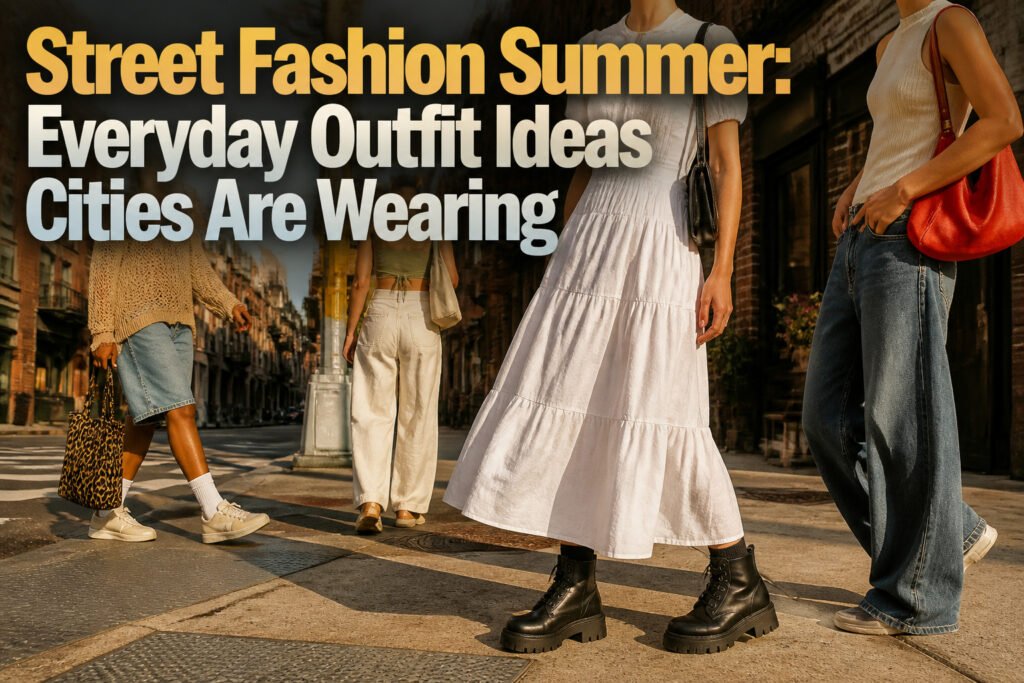
Street fashion summer 2026 is what people are actually wearing on sidewalks right now, not what runway captions claim. The catch is that breathability alone is not enough; an outfit has to move through subway turnstiles, survive asphalt at 3 p.m., and not look like you dressed for a different city by mistake. A white cotton midi with chunky boots underneath anchors the fabric so it stops floating and starts moving with intention.
Classic White Summer Dress

A white cotton or linen dress in summer works because the fabric breathes and the color throws heat back instead of pulling it in. The trick is keeping it from looking like you stepped out of a garden party. Last season I kept reaching for the same ivory midi until a friend asked if I was dressed for brunch or for the city, and she had a point.
Chunky-soled boots underneath change the whole posture of the thing. The weight at your feet anchors all that airy fabric so the dress stops floating and starts moving with intention. Layered chains at different lengths do something similar up top, breaking the blankness without adding bulk that traps heat. A cropped leather jacket slung over your shoulders after dark finishes the look; the proportions stay balanced because the jacket ends where the waist begins, not where the skirt flares.
The base stays cool because cotton and linen let air pass through the weave rather than sealing it against your skin. White reflects rather than absorbs the wavelengths that warm you, which matters more than most people realize when you are standing on asphalt at three in the afternoon. Keep the accessories minimal in color so the contrast reads as deliberate, not accidental. Black boots, silver chains, the jacket in a worn brown: the restraint is what makes it street rather than costume.
90’s Mini Dress

A floral mini dress in a ditzy print hits that sweet spot between throwback and wearable. The hem lands mid-thigh, which matters more than you might think: anything longer snags on bike seats and subway turnstiles, and anything shorter has you tugging fabric all afternoon. White sneakers, not sandals, are what make this a real street outfit. I learned that the hard way after a full day of walking Brooklyn in strappy flats that rubbed raw by hour three. A clean white leather sneaker gives you the cushioning for miles of pavement without killing the ’90s vibe the dress is after. The ditzy pattern, those tiny scattered florals rather than big blown-out blooms, reads as vintage without looking like costume. Pair it with a small shoulder bag worn crossbody and you are basically done.
Matching Two-Piece Set

A matching two-piece set removes the morning decision fatigue that kills momentum before coffee. The pieces were designed to work together, so proportion and color are already resolved.
What separates street fashion summer from looking like loungewear is the fabric choice. Cotton or linen-blend knits with an open stitch hold their shape through humidity instead of sagging by noon. Linen co-ords in oatmeal or sage green breathe better than synthetic sets that trap heat against the skin.
The shoe swap changes everything. Heeled sandals push the same set toward evening, while flat leather sandals or slides keep it grounded for daytime walking. A thin leather belt defines the waist if the cut runs relaxed.
The real value shows up later. That cropped camp shirt works with jeans in September; the wide-leg trousers pair with a tucked tank on their own. The set cost one decision, but the pieces earn their closet space long after.
Bold Maxi Dress

A floor-length dress in a saturated color owns the sidewalk in a way shorts never quite manage. The fabric needs to be light enough to move, though. I learned that watching a woman on the L try to board with a cotton skirt that pooled at her ankles and caught the door. Aim for a hem that brushes the top of your foot, not the ground, and a slit that starts at least mid-calf so your legs can actually stride.
Movement matters most on stairs and escalators. A narrow skirt with no vent turns a subway transfer into a hobble. Wider cuts or a side slit let you take full steps without gathering fabric in both hands.
Prints separate street wear from resort wear. Abstract brushstrokes or oversized geometrics read as deliberate city choices. Tiny florals or palm leaves tend to signal vacation, unless the scale is blown up to dinner-plate size and the ground color is black or navy rather than white. Solid brights, a cobalt or tangerine, need no print at all to hold their own against concrete and glass.
Crop Top and Shorts

A crop top with shorts only reads as street fashion summer when the proportions look intentional rather than like you left the gym. The waistband of your shorts should sit at or just above your natural waistline, with the crop top ending about two inches below your bra band so a slim strip of midriff shows. That gap is what separates styled from accidental.
For inseam length, three to five inches hits the practical sweet spot for walking-heavy city days. Anything shorter rides up; anything longer starts looking like Bermuda workwear unless the cut is deliberately tailored. Fabric weight matters just as much as cut. Lightweight cotton poplin or a crisp linen blend holds its shape without clinging to sweat, which becomes visible the second humidity climbs past seventy percent. Jersey and thin rayon will stick to your lower back within two blocks and read as sloppy before noon.
A structured waistband with belt loops helps, even if you skip the belt. It adds the visual weight that says this outfit was planned, not pulled from a drawer of activewear.
Overalls

Medium-wash denim with a clean, even tone reads current right now, while anything heavily acid-washed or artificially faded at stress points looks like a costume from five summers ago. Straps that sit at two fingers’ width feel intentional and modern; the super-skinny spaghetti straps of the early 2010s or the overly wide carpenter-bib panels both pull the eye toward the hardware instead of the shape.
A fitted ribbed tank underneath handles the midday heat, and a tissue-thin long-sleeve tee layered beneath takes you through evening breezes without adding bulk. The trick is keeping the underlayer close to the body so the overalls still skim rather than bunch.
Pockets matter more than most people credit. Side hip pockets that actually open, not just the decorative slit, let you leave the crossbody bag at home. A hammer loop or phone pocket at the thigh keeps your hands free for iced coffee, a subway pole, or digging through a market bin. The best pairs build in three functional pockets minimum; anything less and you’re carrying a bag you didn’t need.
Summery Romper

The bathroom question stops a lot of women from trying a romper, and it is a real drawback. You are essentially undressed in a stall, which is annoying in a public restroom with a long line or a broken hook on the door. For me, that tradeoff is worth it on mornings when I am running late and need one item that counts as a full outfit. A romper takes the decision fatigue out of getting dressed: no matching top to bottom, no tucking or layering required.
A tapered leg opening that hits mid-thigh tends to flatter shorter frames, while a wider, looser leg elongates taller women but can overwhelm anyone under five-foot-four. Necklines matter more than people expect. A square or straight-across cut leaves room for a thin chain or layered pendant without competing, and a deep V pairs better with statement earrings than with anything at the collarbone. Skip the scarf or neckerchief trend here; the one-piece already draws a strong vertical line, and extra fabric at the throat breaks it.
Oversized Linen Shirt with Wide Leg Trousers

An oversized linen shirt with wide leg trousers only looks intentional if you control where the fabric lands. I learned this the hard way after three mornings of re-tucking in bathroom mirrors. The front-tuck, or French tuck, saves the silhouette: tuck just the front panel two inches into the waistband, let the back and sides hang loose. This creates a waist definition without the bulk of a full tuck. For the trousers themselves, a high rise is non-negotiable here. Mid-rise cuts leave the shirt hem and waistband fighting for the same territory, and the volume on top collapses into the middle. High-waisted wide leg trousers in sand, ecru, or olive anchor the look and let the linen breathe without swimming on you. The coastal palette of soft ocean blues and sun-washed yellows works with this shape too, though I stick to neutrals when I want the outfit to carry from a morning coffee run straight into evening plans without a change. Flat leather sandals finish it; anything heavier fights the trouser hem.
Graphic Tee and Denim Shorts

The graphic tee and denim shorts pairing lives or dies by the print you choose. Retro band logos, faded anime prints, and minimalist typography all read as current for street fashion summer, while stiff, brand-new concert merch tends to look like a costume. Soft cotton or a cotton-blend that drapes loosely matters more than the exact image; stiff fabric clings and ruins the relaxed shape.
Short length should clear your stride without riding up. High-rise cutoffs with a raw hem give that undone feel, and light-wash denim keeps the outfit summer-bright where black denim shifts it downtown.
White low-top sneakers or retro runners are the reliable base, but swapping in loafers instead of sneakers adds polish without losing the casual spirit. A woven crossbody bag and a neutral baseball cap finish the look so it reads intentional, not like you grabbed the first clean shirt.
White Cotton Sundress with Flat Sandals

A white cotton sundress only reads as street fashion summer when the sandals can handle actual pavement. Straps between one and two inches across the foot stay put without the wobble of a barely-there string, and an ankle strap that sits low, right at the ankle bone rather than circling the calf, keeps the heel from lifting on cracked sidewalks. I learned that width distinction the hard way after a day of chasing down a bus in quarter-inch straps that stretched and slid until I was gripping with my toes.
The dress itself is almost too simple for city wear, which is exactly why the bag matters. A slouchy leather crossbody or a small canvas tote in an unexpected color, mustard or a washed teal, adds the intentional look that separates street style from beach cover-up. Jewelry should stay small: a thin chain, a single small hoop, nothing that competes with the clean line of the neckline. Scale down the metal so the cotton stays the point.
Crochet Top and High-Waisted Wide Leg Pants

A close-weave crochet crop top in white or cream reads as finished enough for city streets, but lining it with a thin cotton camisole keeps the look public-appropriate without turning it into a heat trap. The weave itself provides the coverage decision: open patterns need the layer, tight ones often do not. I learned this the hard way after assuming all crochet carried the same dress code.
The real payoff comes from pairing that textural top with smooth, high-waisted wide-leg pants in linen or Tencel. The contrast between the handmade-looking knit and the clean drape below creates visual depth that no extra layer of jewelry could replicate. The pants should sit right at your natural waist to draw a sharp line between the skin shown above and the flow below.
Sand, olive, or terracotta grounds the outfit in neutrals that feel intentional rather than leftover-from-festival. Flat strappy sandals in a matching tone keep the leg line long without competing for attention.
Floral Midi Dress and Strappy Sandals

The midi length dominates street photography for a simple reason: it moves without staging a reveal. A hem that hits between mid-calf and the ankle catches pavement breezes, shows enough leg to read as summer, and never demands the wearer pause for modesty on a subway stair. Cotton voile or a viscose blend keeps the skirt from ballooning into costume territory; the fabric falls rather than floats.
Sandals need the same practicality. A heel between one and two inches stays walkable on concrete for hours, while anything over three turns a city afternoon into an exercise in locating benches. Strappy styles in a tone close to your skin visually extend the leg line without competing with the print.
The romantic register tips into occasion-wear when the accessories pile on. One delicate gold necklace reads daytime; layered chains and a rattan bag start whispering garden party. Hair in soft waves rather than a set style keeps the whole thing from looking like you dressed for an event and got lost on the way. The wrap silhouette, the smocked bodice, the simple A-line: any of these work, but the dress should look like you reached for it Tuesday morning, not saved it for Saturday.
Halter Top and Palazzo Pants

A halter top draws the eye straight to the shoulders and collarbone, which is flattering if you carry your width across the upper back or have a longer neck to balance the cut. The trouble starts lower down: the bare back leaves no hook band to hide, so a strapless bra or adhesive cups become your only real options. Some halter styles include a built-in shelf, but most summer versions in linen or lightweight knit do not, and the gap between fabric and skin at the side seam can show a traditional band no matter how low you try to sit it.
The palazzo pants save this pairing from looking too bare above and too heavy below, but only if the fabric has enough body. A lightweight crepe or linen blend, around the weight of a good dress trouser rather than a beach cover-up, keeps the leg from ballooning around you on a subway platform or catching every gust between buildings. The high waist matters here too: it anchors the cropped or fitted halter and creates one long vertical line. Without that waist definition, the wide leg can read as volume on volume, and the whole silhouette loses its shape. Flat sandals or a low block-heel mule keep the hemline clean and the look grounded for an actual day of walking.
Oversized Button-Down Shirt as Dress
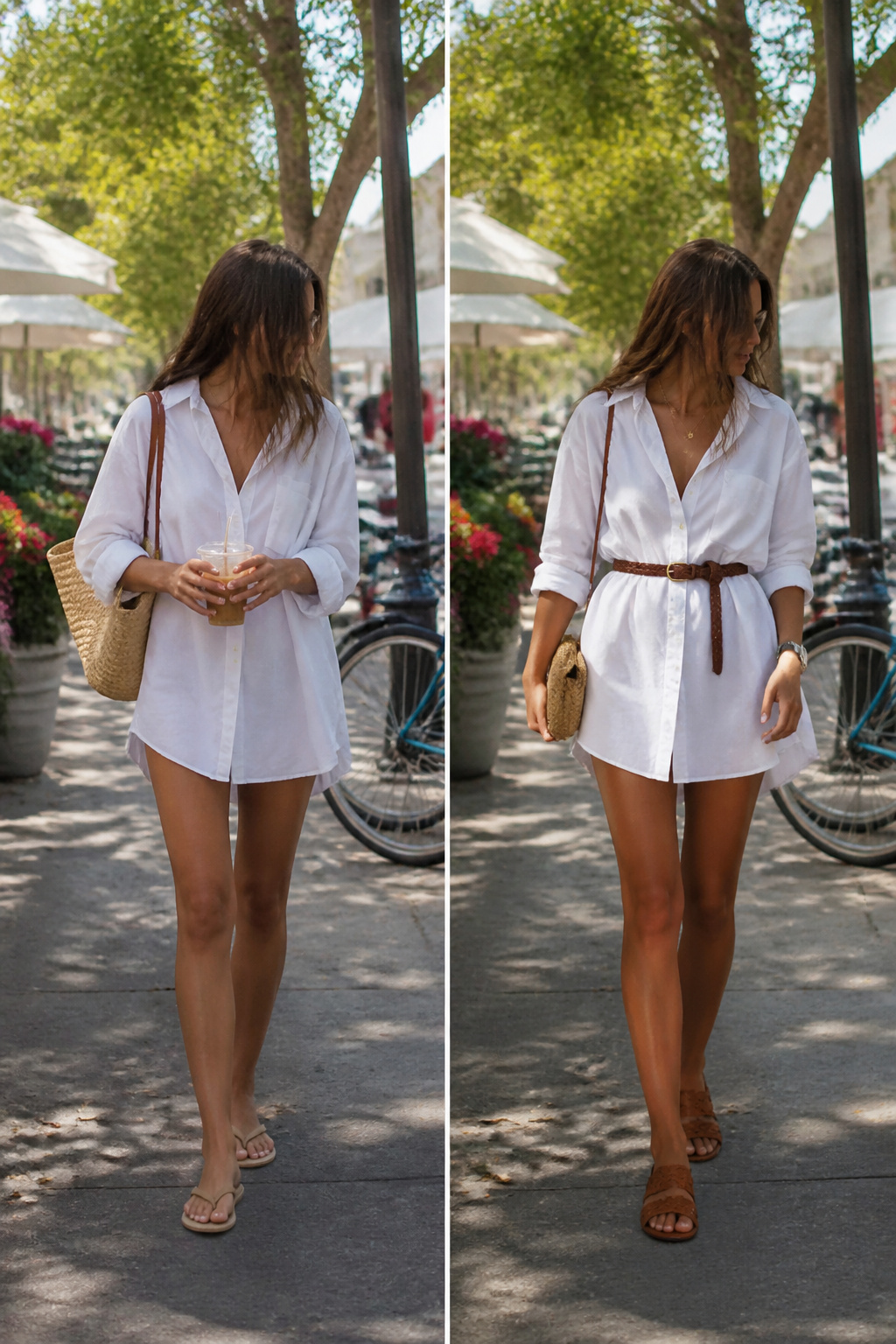
A crisp cotton button-down worn as a dress only works if the hem hits mid-thigh or lower; anything shorter risks shifting into territory that feels exposed on a subway platform or at a coffee-shop counter. The front closure needs reinforcement for real movement. A single loose button gaping open on a windy corner is not the look, so add a hidden snap or a small safety pin at the chest, or choose a shirt with a placket that lies flat and stays flat.
Belted, a thin leather strap at the waist creates shape against the dropped shoulder and longer back hem. Without one, the silhouette stays intentionally undone, more borrowed-from-him than styled. The no-belt route needs heavier shoes to anchor the volume: clean white sneakers carry enough visual weight. Minimal flat sandals work better with the belt, since the cinched waist already gives the eye a center point and the lighter shoe does not compete.
Denim Jacket Over Floral Maxi Dress

A denim jacket over a floral maxi dress solves the summer problem nobody plans for: stepping out of 85-degree heat into a restaurant or office cranked to 65. The trick is keeping the layer from eating the dress. A slightly oversized cut in a vintage wash or light blue denim preserves the line underneath without looking like you borrowed from someone else’s closet. The softer the jacket, the less it fights the fluid, tiered silhouette of the dress.
Washes matter more than most people think. Light blue denim or a faded vintage wash sits quietly against soft florals in lavender, sage, peach, or butter yellow. Dark indigo or rigid raw denim shouts over those colors and turns the pairing into a costume. Roll the sleeves to just below the elbow when you walk in somewhere cold, then push them above the elbow or let them scrunch at the forearm as you warm up. That one move changes the whole proportion and keeps you from sweating through the transition back outside.
White leather sneakers or flat sandals keep the look walkable, and the combination works for coffee runs, weekend trips, and casual evening strolls without needing a bag swap.
Breathable Fabrics

Linen and cotton own summer street fashion for one reason: they let air move. An open plain weave or a loose basket weave turns a shirt into a vent, pulling heat off skin instead of sealing it in. The gaps between threads matter more than the fiber itself, which is why a dense cotton poplin can feel stifling while a gauzy linen button-down keeps you cool at noon.
Cotton jersey is where shoppers get tripped up. A lightweight 150–180 gsm jersey drapes and breathes; the heavier 200+ gsm stuff that fast fashion labels push for opacity sits like a sauna. The lighter weight costs more because it requires better yarn, not more of it. The label rarely states grams per square meter, but your hand can tell. Pinch the fabric and let it drop. Quality cotton jersey recovers quickly and feels cool against your palm. Cheap jersey lands heavy and stays creased.
Linen demands a different bargain. It wrinkles within an hour of wearing, full stop. The same hollow fiber that wicks sweat also refuses to hold a press. Summer street style has largely stopped fighting this. The rumpled sleeve, the crushed collar, the seat crease on a pair of wide-leg trousers: these read as intentional now, part of the fabric’s character rather than a laundry failure. Trying to steam linen into submission between subway stops is a losing game. Better to buy the cut slightly roomy so the creases fall into the drape rather than fight it.
Casual to Dressy Balance

A single shoe swap carries most of these outfits from coffee run to dinner reservation. The flat sandals that worked for a 9 a.m. walk through the market get replaced by a block heel or a slim mule, and the whole silhouette shifts upward without changing anything else. Jewelry does the heavier lifting for pieces that already read polished in daylight. A small gold hoop becomes a shoulder-grazing chain, or a bare neckline picks up a single sculptural pendant that catches restaurant light.
The pieces worth keeping in a work bag are the ones that add structure without bulk. A foldable block heel in soft leather packs flat and weighs less than a water bottle. One medium-size earring in a pouch, a belt that can cinch a loose dress or define a blazer, and a lipstick in a deeper tone than the daytime shade. That is the full kit. Anything more, and the bag stops being portable and starts being a burden you leave under the desk.
Accessories That Anchor the Look

Summer outfits leave little room to hide, so the accessories you choose end up doing more work than they do in any other season. A bag that sits wrong or earrings that tug after an hour turn a good walk into something you cut short, and that defeats the whole point of dressing for the street.
Crossbody bags sized for a phone, keys, and one small wallet keep your hands free without bouncing against your hip. Anything larger, and the strap starts digging in once the temperature climbs past eighty and your shoulder gets slick with sweat. Lightweight hoops or small studs finish the look without that slow ache that builds behind the earlobe by mid-afternoon. Sunglasses need UV400 labeling, not just dark tint, because pupil dilation in shade lets more damage through than no glasses at all. The minimal clothing that makes summer dressing bearable also strips away the places you normally tuck your essentials, so every piece you add has to justify its weight against what it replaces.
Summer Color Directions

Soft ocean blues and sandy neutrals have become the backbone of this summer’s street fashion, and the easiest way to wear them is through oversized silhouettes in relaxed fabrics. A pale blue oversized button-up with cream trousers reads polished without trying too hard, which is exactly what city heat demands.
Butter yellow and faded coral work best here as accents rather than base colors. A butter yellow bag against an all-cream linen set, or faded coral earrings with a soft blue shirt, adds warmth without tipping into beach-resort territory. The trick is keeping the accent to one piece so the outfit stays grounded.
Olive green functions as a neutral alternative that pairs naturally with both the coastal palette and the brighter accents. It carries the same versatility as sand or soft gray but adds subtle depth, especially in utility-inspired pieces that keep the look from feeling too literal. Many fashion creators are mixing coastal palettes with sporty or utility pieces for exactly this reason: the combination reads fresh rather than themed.
Frequently Asked Questions
What are the biggest summer trends still popular from 2025?
Oversized linen sets, cargo pants, retro sportswear, sheer layering, coastal color palettes, and statement accessories remain among the most popular styles. The article highlights matching two-piece linen sets, graphic tees with denim shorts, and oversized linen shirts with wide leg trousers as key looks for street fashion summer 2026. Coastal tones like soft ocean blues and sandy neutrals continue to anchor the season’s color direction.
How can streetwear style work during hot weather?
Lightweight fabrics, oversized silhouettes, breathable sneakers, and relaxed layering create comfortable summer streetwear. The article emphasizes linen and cotton with open weaves that let air move through the garment rather than trapping heat against skin. Chunky-soled boots, flat leather sandals, and clean white sneakers ground airy pieces without adding bulk that traps warmth.
Are cargo pants still fashionable this year?
Yes. Cargo pants and utility-inspired bottoms continue to trend because they combine comfort, practicality, and strong street style appeal. The article notes that relaxed cargo pants with exaggerated pockets and lightweight technical fabrics remain central to current summer trends. Neutral utility shades like khaki, charcoal, cream, and washed black pair easily with brighter accessories.
What colors are trending for summer fashion?
Soft blues, sandy neutrals, butter yellow, faded coral, olive green, and monochrome palettes are currently leading seasonal fashion trends. The article specifically calls out sand, ecru, and olive for wide-leg trousers, plus soft ocean blues and sun-washed yellows as coastal alternatives. Butter yellow and faded coral work best as accents against cream or neutral linen bases rather than as full outfit colors.