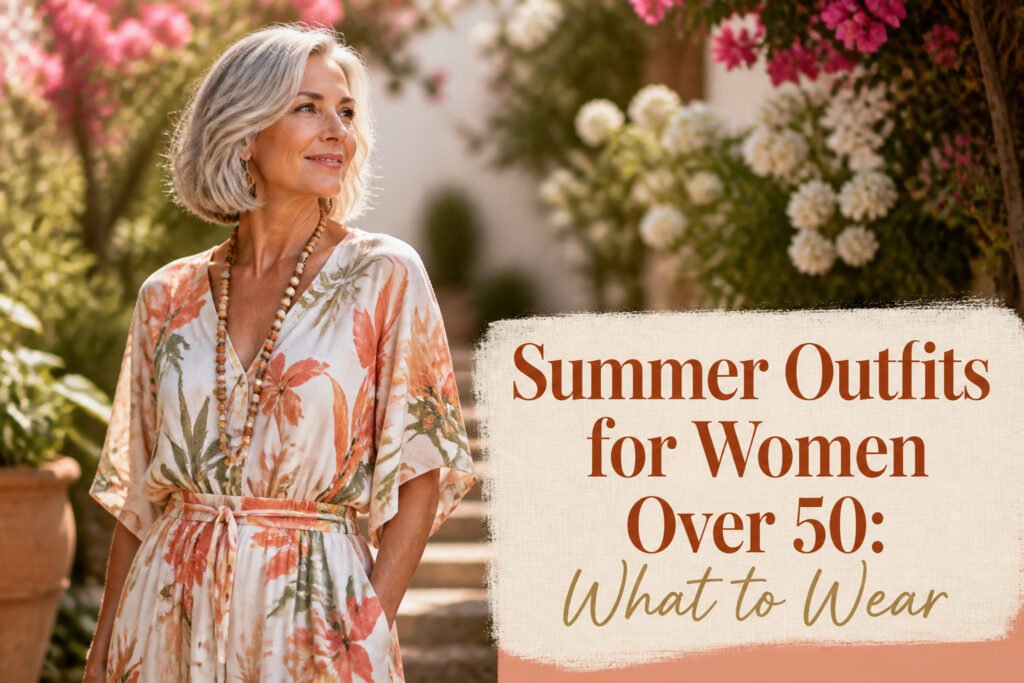
Summer outfits for women over 50 in 2026 are built around pieces that breathe first and flatter second. The catch is that the same airy fabrics that keep you cool, linen under 5 ounces per yard and 100% cotton, wrinkle into looking accidental by noon if the cut isn’t intentional enough to carry the rumple. A single good cotton dress at roughly $89 replaces three separate bottoms in a travel bag, but only if the straps are removable and the hem works past sunset.
Flowy Dresses

A flowy dress is the closest thing to a complete summer outfit that takes roughly sixty seconds to put on. The loose cut keeps fabric from clinging in humid heat, and the right length works for a backyard lunch or a dinner that runs past sunset. Cotton that actually breathes matters more than the silhouette; a 100% cotton piece will let air move against skin in a way blended knits do not.
What convinced me, reading through the recommendations that keep surfacing for this age group, is how often the same details repeat: removable straps on a floral print so the dress stays put, a tiered white style that reads as crisp rather than juvenile, a simple black version dressed down with a straw bucket hat or up with gold jewelry. The versatility is in the fabric and the cut, not in packing a separate outfit for every block of the day.
Price points land where you would expect for natural materials. The lightweight long dresses that came up most often sit around $89–$90, with silk tops pushing closer to $130 and simpler raglan-sleeve toppers near $80. The stretch shorts and cropped jeans mentioned alongside them run $40–$80, but a single good cotton dress replaces several of those pieces on a trip.
Wide-Leg Pants

Wide-leg pants earned their spot in my summer rotation the first time I tried linen that actually moved with me instead of clinging. The roomier silhouette lets air circulate in a way slim cuts never manage, and the drape creates a line that feels intentional without trying hard. Fabric matters more here than with any other bottom: linen and gauze keep the shape from feeling heavy, while cotton stretch denim gives the cropped versions enough structure to wear out to dinner.
Proportion is where these pants quietly do their best work. The volume below balances a closer-fitting top or a tucked-in shirt without the fuss of belting everything into submission. A black tank against crisp white wide-legs reads as polished for warm evenings; a relaxed short-sleeve top in a matching gauze set looks like effort even when it isn’t. I tend toward minimal accessories with the louder silhouettes, a woven bag and simple slides, though a long pendant necklace can draw the eye vertically if the cut feels too horizontal.
The cropped versions hit at that useful point between casual and put-together, comfortable enough to lounge in yet structured enough for occasions. What sways the decision for me is the waist: a flat elastic band sits smoothly under a tucked top, while a button-and-fly with pockets reads more finished. Both work; neither requires the shapewear I resent in July.
Linen Tops

Linen breathes in a way cotton only pretends to. The fibers are hollow, so air moves through the weave instead of trapping heat against your skin, and after a few washes the fabric softens without losing its structure. That structure matters after 50, when drape becomes more important than cling. A linen button-down from Lands’ End, light blue or striped, gives the shoulders definition while the body skims rather than grips. The front tuck defines the waist without the tightness of a tuck-and-belt situation.
Pairing options are straightforward. White denim turns the shirt into a summer uniform; the contrast reads crisp without trying for formal. Linen-on-linen, say navy Quince pants with a tonal top, works for days when comfort is non-negotiable but pajamas are not an option. A bamboo-handle bag or woven bracelet adds texture so the monochrome does not flatten out entirely.
The wrinkle factor is real, and the choice is whether to fight it or own it. Steaming helps, but linen will never look pressed past noon. That rumpled quality reads as relaxed on a body with some history to it, less "just rolled out of bed" than "has somewhere interesting to roll back from." Wash cold, hang dry, and the fabric lasts years while getting better.
Comfortable Sandals

A pair of flat sandals that are comfy on the feet can carry you from poolside to dinner without the costume-change hassle, and that versatility matters more in summer than any single dress. The mistake is treating comfort as the opposite of polish. Wedge heels or stylish flats in neutral tones pair with anything in your bag, and sporty, comfy sandals now read as fashion-forward rather than a concession to age. What separates the keepers from the throwaways is support you can actually feel after an hour on concrete. Heat changes what works: materials that breathe and straps that do not cut in become non-negotiable as temperatures climb. A chunky beaded necklace or lightweight scarf can finish the look, but the sandal itself has to earn its place through structure, not just styling. Neutral tones in footwear are always a safe bet because they extend your outfit options without adding bulk to a travel capsule. Skip the super high heels; the sources agree that comfort and style now overlap rather than trade off.
Classic White Jeans

Classic white jeans brighten every summer outfit, and the right pair feels nothing like the stiff denim of decades past. Stretchy waistbands and lightweight fabric matter more than ever after 50, especially when a cropped, straight-leg cut flatters without clinging. I size down when the stretch is generous enough to allow it, which turns a maybe into a definite yes in the dressing room.
What sits on top makes the look. A linen button-up, front-tucked to define the waist, channels the same crisp authority as a power suit minus the boardroom. Light blue or striped linen reads fresh against white, and slide sandals keep the whole thing easy for days with lots of in-and-out of the car. Straw or rattan accessories push it toward summer chic without trying too hard.
The real work is keeping them clean. I wash white denim separately, cold, and never let a spill set while I am out. A small stain pen lives in whatever bag I carry that day. Fresh white jeans fail the outfit faster than any other piece when they go dingy, so retirement happens the moment they do.
Lightweight Cardigans

A lightweight cardigan turns sleeveless pieces into outfits that work past sunset, which matters more after 50 when bare shoulders feel less comfortable as temperatures drop. Fabric weight makes or breaks this move: cotton gauze and featherweight merino add warmth without bulk, while anything over about six ounces per square yard defeats the purpose. The best ones hit at mid-hip or just below, long enough to elongate the torso but short enough to wear untucked without looking swallowed.
Three-quarter sleeves read more polished than full length in summer, and they stay clear of iced coffee cups and garden dirt. Draped fronts work better than buttoned styles for this kind of layering; they hang open and move with you instead of adding horizontal breaks where you do not want them. A cardigan in the 24–28 inch range will cover the hip without cutting the leg line, which is the length that kept my eye moving when I was sorting through options for this piece.
Color matters for versatility. Soft white, faded navy, or a warm stone tone will sit with almost any summer print without fighting it. The cardigan does not need to be the star; it needs to make the sleeveless dress or tank you already own wearable three more hours into the evening.
Maxi Skirts

A floaty maxi skirt covers what shorts expose without the uniform stiffness of a calf-length cut. The full length moves air against the legs on hot days, and the right fabric, linen or another breathable weave, keeps the silhouette from becoming a tent. I look for a pull-on waistband and enough movement that the skirt sways rather than clings.
The trick is proportion. A close-fitting tank or shell on top keeps the balance from going shapeless, especially with a print or bold pattern below. Solids work too, a white skirt paired with any color top, or taken all-white for a cleaner line. I dress these down with flat sandals for daytime errands, then swap in wedges and a woven bag for evening. The same skirt handles both without looking like it tried too hard.
What stops me is the wrong shirt. Too voluminous on top and the whole outfit reads as hiding rather than choosing. Too short or too cropped and the waistband sits awkward. A shell that hits at the hip, fitted but not tight, solves it every time.
Casual Shorts

Shorts still earn their place in a summer wardrobe after 50, though the cut matters more than it used to. A 5-inch inseam hits the workable middle for most women, long enough to avoid the weekend-camp look but short enough to keep cool. Some prefer longer, some shorter, and either choice holds up if the leg stays relaxed rather than fitted tight to the thigh.
Fabric and styling pull shorts out of errand-only territory. Linen or a linen blend breathes and holds a pressed look through a warm afternoon. Pairing them with a soft blouse that has some movement reads more intentional than a basic tee. Raffia accessories, a woven belt, or a structured sunhat add texture without trying to dress the outfit up into something it is not.
The loose leg opening does the slimming work here, especially for weight carried lower on the body. An elastic waist keeps the comfort real for travel or long days outside. Black double gauze works as a neutral base, styled back to a white v-neck and linen espadrilles, or broken up with color pulled from a patterned top.
Striped Tees

A striped tee in the right scale reads as a neutral with just enough pattern to keep a summer outfit from going flat. The sources point to two ways to play this. A finer stripe, like the blue and white Alice Walk tee, sits closer to a solid and pairs cleanly with chinos and slide sandals for that coastal look. A bolder navy and white stripe, especially in a tunic-length linen cut, carries more presence and works buttoned up with white jeans or open over a tank like a light jacket.
Fit matters more than the stripe itself. A tee that skims without clinging lets the pattern do the work; anything too boxy and the stripes start to read costume. The mariner tee from Lands’ End and similar options from Talbots hit that middle ground at a lower price point than the Alice Walk version.
What makes the striped tee worth the space in a summer wardrobe is how hard it works for the effort. One shirt, multiple scales of stripe, and you have something that functions across errands, lunch, and travel without looking like you reached for the same uniform every morning.
Jumpsuits

A jumpsuit solves the morning question of what goes with what, but not every cut earns its place in a summer rotation. The ones worth the effort have either buttons down the front or enough stretch in the fabric to make bathroom breaks manageable. A back zipper turns a simple errand into a contortion act, and that single detail is what separates the piece that gets worn weekly from the one that hangs untouched.
The silhouette matters more after fifty than it did at thirty. A defined waist or a relaxed wide leg through the hip keeps the line clean without clinging. My own preference runs toward solid colors in breathable weave, dressed down with flat sandals for grocery runs or lifted with yellow accessories against a blue base for dinner out. The color pop does more work than matching ever did. A self-belt or a cropped jacket on top shifts the same piece from poolside to patio without changing the foundation underneath.
The trick is buying for the body you have now, not the one that wore jumpsuits effortlessly decades ago. A front placket and a little give in the cloth, and the ease finally outweighs the effort.
Skirts

Skirts fill the gap shorts leave behind without the same fit headaches. An asymmetrical hem on a brocade floral, for instance, reads as the grown-up version of the micro-mini trend: the uneven line adds length while still showing some leg. That shape works with a plain tee and flip-flops for errands, or a blouse and suede sandals when the occasion calls for more.
A calf-grazing white skirt has nearly a century of summer history behind it, though the length can skew matronly if the styling stays too safe. The fix is pairing it with something that breaks the uniform association: a ribbed tank and ballet flats for day, or sharper tailoring with oversized sunglasses after five.
For evening, a floaty maxi in breathable fabric with a pull-on waistband covers pale legs and still feels graceful. The key is balance: keep the top fitted, a close tank or shell, so the silhouette does not overwhelm. Prints work, but solids travel farther in a packed bag.
Tunics

A tunic hits at mid-thigh or just above the knee, which is the length that actually does the work of lengthening the leg line without requiring a heel. The proportion that keeps it from looking like a tent is simple: the hem should clear the widest point of your hip by a few inches, and the pants underneath need to be slim or straight, never wide. I learned this the hard way after pairing a long tunic with bootcut linen pants and spending an afternoon catching my reflection in shop windows, wondering why the whole outfit looked like loungewear.
Gauzy fabrics in cotton or a cotton blend breathe in humidity and recover from a suitcase better than linen, which wrinkles into a map of every crease you sat on. A neutral or darker gauze reads as more finished than white, which can turn into a single-use garment the minute sunscreen or salad dressing gets involved. The same tunic works over a tank dress like a jacket, tied at the waist, or thrown on straight after swimming with flat leather sandals. That versatility matters when you are packing for two weeks and refusing to check a bag.
Kaftans

A gauzy kaftan in the right fabric weight does what a basic tee cannot: it reads as refined cover-up at eleven in the morning and still earns its place at a waterfront dinner table after seven. The difference between the two moments is the fabric. Beach-weight cotton voile or open-weave linen is sheer enough to dry quickly and layer over a swimsuit, but it needs an opaque slip or a darker print to leave the sand. A mid-weight silk-cotton blend with a tighter weave drapes differently, holds embroidery or beading, and passes for evening without apology.
The line between a kaftan and a tunic matters more after fifty than it used to. A tunic hits mid-thigh and expects pants underneath. A kaftan is cut fuller and longer, with a length that lets it stand alone. That extra volume is what makes it forgiving in humid heat, though it can swallow a smaller frame unless the shoulder seam sits precisely or a drawstring waist creates shape.
The fabric weight decides where you can wear it, not the cut. Pack one in each weight and the same silhouette carries you through a week with two pairs of sandals.
Graphic Tees

Graphic tees walk a fine line after fifty, and the wrong print can make an outfit feel borrowed from a teenager’s drawer. Small-scale graphics, abstract art, or typography in muted palettes read as intentional rather than accidental youthfulness, while oversized logos and cartoon characters tend to fight against the sophistication most women in this age range have spent decades cultivating. The sources consistently emphasize that confidence comes from pieces that highlight personality without sacrificing timelessness, and that balance applies directly here.
Quality markers separate the keepers from the giveaways. A mid-weight cotton that holds its shape through washing, stitching that lies flat at the collar and hem, and a print that sits in the fabric rather than cracking on top of it, these details matter more than the graphic itself. The Ines de la Fressange approach referenced in capsule discussions, relaxed but never sloppy, works because the fit follows the body without clinging or drowning it.
Styling determines whether the tee earns its place. Tucked into high-rise trousers with a leather belt, layered under an unbuttoned linen shirt, or paired with structured white jeans and real jewelry, the same print shifts from weekend-only to genuinely versatile. The mistake is treating a graphic tee as a complete statement instead of one element in a considered outfit. Casual summer dressing, as the sources note, still demands that you look put-together; the graphic should start a conversation, not shout over it.
Cropped Pants

Cropped pants land at the ankle bone, and that exact break is what keeps them from looking like you outgrew last year’s full-length pair. The sources point to a mid-rise or higher as the waist that actually holds; anything lower and the cropped line cuts the leg at its widest point instead of its narrowest.
White denim in a straight-leg crop gets its summer mileage from stretch that lets you size down without losing shape, and a lightweight weave that skips the stiff, heavy feel of winter jeans. Linen pull-ons work the same territory with a drawstring or elastic waist and the same cropped hem. Both read as intentional only when the ankle shows.
Footwear makes or breaks the proportion. Slide sandals keep the look easy and grounded; the flat line of the sandal mirrors the flat line of the crop. Anything with a strap that wraps the ankle competes with the hem and shortens what the crop was meant to lengthen.
Fabrics That Actually Cool

Linen and cotton earn their place in a summer wardrobe for one reason: they move heat away from the body instead of trapping it against your skin. Linen in particular has that slightly rumpled look that reads relaxed rather than sloppy, and a lightweight button-down in the fabric pairs with white ankle-length pants for something crisp without trying hard. The weight matters more than the fiber name on the tag. A heavy cotton twill will cook you; a loose-weave cotton or linen under 5 ounces per yard actually lets air through.
Synthetic blends have a role too, though I used to skip them entirely. The right ones wick moisture and dry fast, which matters on days that swing between air-conditioned interiors and humid sidewalks. I look for cotton-modal or linen-rayon mixes when I want the drape of linen without the full wrinkle factor. Pure linen still wins for breathability, but a blended fabric holds its shape through a long day of travel or back-to-back errands.
Pull-on linen pants with a wide leg add another advantage: the cut itself creates breeze. High-waisted and pleated, they feel as airy as shorts but look more intentional. For skirts, a flowy midi in cotton does the same work, feminine without clinging. The mistake is choosing tight weaves in any fiber; if you hold the fabric up and cannot see light through it, it will not cool you.
Building a Mix-and-Match Core

A small summer wardrobe only earns its space when every piece talks to at least three others. That math works out to roughly one pattern for every three solids, a ratio that keeps things interesting without turning getting dressed into a puzzle. Patterns on the bottom half, solids up top, and you can swap in either direction for dinner or a morning walk.
I learned this the hard way after buying three floral blouses in one season. Pretty alone, but they fought with every printed skirt I owned and left me with half as many outfits as the number of hangers suggested. Solids do the quiet work: a navy linen shirt, an ivory jacket, a soft gray trouser. They absorb the wild card, the striped tee, the one pair of cropped pants with a small geometric print.
The real test is the five-minute morning. Can you reach for anything clean and have it make sense? If one piece demands a specific shoe, a certain earring, a particular mood, it is not core. It is costume. The core holds up through heat waves and unexpected invitations, through the days you feel like making an effort and the ones you do not.
What Age-Appropriate Actually Means

The phrase "age-appropriate" lands differently once you’ve spent a decade or two watching trends cycle back around. What felt off-limits at 45 often looks perfectly reasonable at 55, and the shift has less to do with the clothes than with who’s wearing them. Confidence, not a rulebook, is what makes an outfit work on a body that’s lived through a few summers.
The sources that actually study how women over 50 dress keep returning to the same point: personal expression matters more than compliance. One longtime style writer puts it plainly, clothing and style are meant to showcase your inner personality, not cause stress because we are worried about what others think. Another notes that preferences change with age, including the clothes you wear, but calls fashion a creative outlet with no rules, just guidelines and suggestions that you can choose to adhere to, or not.
What changes over time is not the permission to wear something, but the desire to. The woman who once fought for the last romper in her size at twenty-two may genuinely prefer a seated concert with drink in hand by fifty-two. That is aging, not surrender. The best summer outfits for women over 50 treat the body as it is now, flatter the figure you have, and leave room for the taste you’ve spent decades refining. The sources agree: think differently, have fun, and let the clothes highlight your personality rather than apologize for your age.
Accessories That Earn Their Space

A raffia tote and a woven belt add texture without competing with the outfit underneath, and that distinction matters more after fifty than it did at thirty. The straw sunhat I reach for most has a wide enough brim to cast shade past my shoulders, which means the SPF on my chest actually gets to do its job instead of fighting direct noon light.
For jewelry, a single silver and blue layered necklace does more than three competing pieces. I used to pile on bracelets until the noise cancelled itself out; now one strand with some shine against a plain blouse reads as intentional. The same rule governs bags. A small navy leather crossbody that fits phone, keys, lipstick, and cards keeps hands free and shoulders level, which becomes its own kind of polish by hour four of a summer afternoon. One accessory should answer a problem: sun, bulk, or the flatness of a solid-color dress. Everything else stays in the drawer.
Frequently Asked Questions
What are some summer outfit ideas for women over 50?
Flowy cotton dresses, wide-leg linen pants paired with fitted tops, linen button-downs with white jeans, and maxi skirts with close-fitting shells all work well. A lightweight cardigan over a sleeveless dress extends the outfit into evening, and a well-chosen jumpsuit solves the matching problem in one piece.
How can I style summer outfits for women over 50?
Balance volume with fit: wide-leg pants need a tucked or closer top, while a full maxi skirt needs a fitted shell above. Keep roughly one pattern for every three solids so pieces swap easily. Neutral sandals and a woven bag finish most looks without overthinking.
What fabrics are best for summer outfits for women over 50?
Linen and cotton breathe best because they move heat away from skin rather than trapping it. Look for loose-weave linen or cotton under 5 ounces per yard so air actually passes through. Linen-rayon or cotton-modal blends hold shape better for travel if you want fewer wrinkles.
Are there any specific colors to wear in summer for women over 50?
Soft neutrals such as white, navy, ivory, and warm stone do the heavy lifting, with one bolder piece for contrast. A single patterned item among three solids keeps packing simple without going flat. White denim brightens everything but demands diligent washing to stay crisp.
What shoes should women over 50 wear in summer?
Flat sandals with real support work from poolside to dinner if the structure is there. Wedge heels or polished slides in neutral tones pair with nearly anything and keep a travel capsule lean. Skip ankle straps with cropped pants, since they compete with the hem and shorten the leg line.